


What if your risk number punished your best months the same as your worst?
That sounds wrong.
Yet many popular measures treat every swing as equal.
The Sortino ratio fixes that by only counting the downside, the returns that fall below a floor you set.
In this post I’ll show what Sortino measures, how the math works in plain steps, when it gives a clearer picture than other ratios, and the practical limits you need to watch before deciding.
Core Explanation of the Sortino Ratio

The Sortino ratio tells you how much return you’re getting for the downside risk you’re taking. Unlike metrics that freak out over every price swing, this one focuses on the volatility that actually stings: losses. It’s built to answer one question: “Am I being compensated enough for the chance this thing drops below what I’m willing to accept?”
Downside deviation sits at the heart of the calculation. Instead of treating every monthly move as equally dangerous, the Sortino ratio zeros in on returns that fall below whatever threshold you set. Could be 0%. Could be 5%. Could be the rate you’d earn sitting in Treasury bonds. By squaring only those negative deviations, averaging them, and taking the square root, you get a number that captures how often and how badly a portfolio disappoints. That’s closer to what investors actually experience than a formula that punishes big upside surprises the same way it punishes crashes.
The Sharpe ratio penalizes all volatility. If a fund jumps 15% one month and 8% the next, Sharpe treats that variability as risk. Sortino doesn’t care. It only worries when returns drop below your floor. That makes Sortino especially useful for evaluating strategies built to protect capital or deliver steady income, because those investors aren’t scared of lumpy gains. They’re scared of drawdowns.
Formula and Component Breakdown
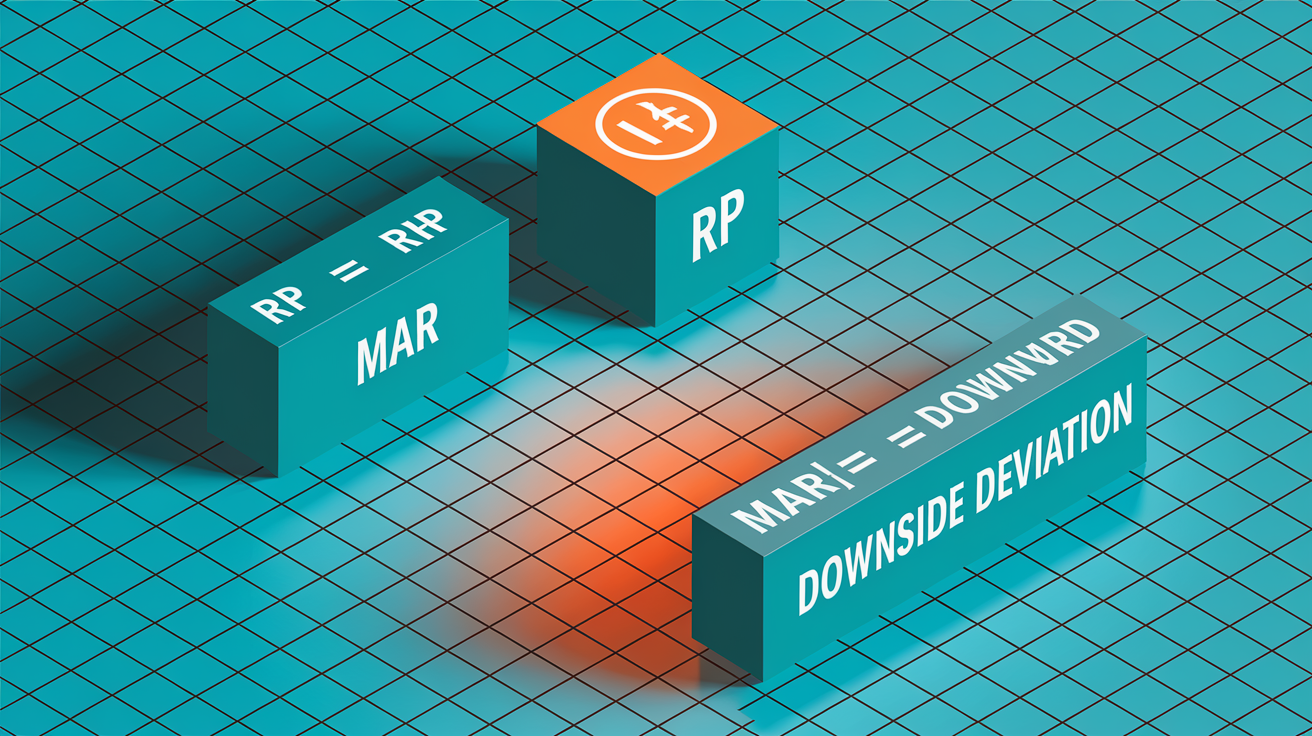
The Sortino ratio divides excess return by downside deviation. The numerator is simple: you subtract your minimum acceptable return (MAR) from the portfolio’s actual return. The denominator captures only the bad periods.
Each piece plays a specific role:
Portfolio Return (Rp): The average return over whatever period you’re measuring. Annualized if you’re comparing strategies year to year, or kept as monthly if that’s how your data looks.
Minimum Acceptable Return (MAR): Your floor. Common picks include 0% (anything below zero is unacceptable), the risk-free rate (what you’d earn on short-term Treasuries), or a target return that matches your financial goal.
Downside Deviation: Calculated by grabbing every return below MAR, subtracting MAR from each one, squaring those negative differences, averaging the squared values, and taking the square root. The math looks like: sqrt((1/N) × Σ[min(0, Ri − MAR)]²).
Final Ratio: (Rp − MAR) ÷ Downside Deviation. The result tells you how many units of excess return you earned per unit of harmful volatility.
When the portfolio return sits above MAR and downside deviation is low, the ratio climbs. When returns dip below MAR often or severely, downside deviation rises and the ratio falls. The formula rewards consistency and punishes painful drawdowns, which lines up with how most investors think about risk when they’re saving for retirement or a down payment.
How to Interpret the Sortino Ratio

Higher Sortino ratios mean better risk-adjusted performance. A ratio of 2.0 says you earned two units of excess return for every unit of downside risk. A ratio of 0.5 means you barely earned half a unit of return for each unit of downside volatility. That’s a lousy trade.
Common ranges:
Below 0.0: Returns fell short of your MAR. The investment underperformed your minimum target.
0.0 to 1.0: Weak to acceptable. You’re earning some excess return, but downside volatility is eating into your risk-adjusted performance.
Above 1.0: Good. You’re getting solid compensation for the downside risk you’re taking. Above 2.0 is often considered strong. Above 3.0 is rare and usually signals exceptional downside control or very favorable market conditions during the measurement period.
Context matters. A Sortino of 1.5 during a calm bull market means something different than a Sortino of 1.5 during a volatile recession. Always check the time period, the MAR choice, and the asset class before deciding whether a given number is impressive.
Sortino Ratio vs Sharpe Ratio
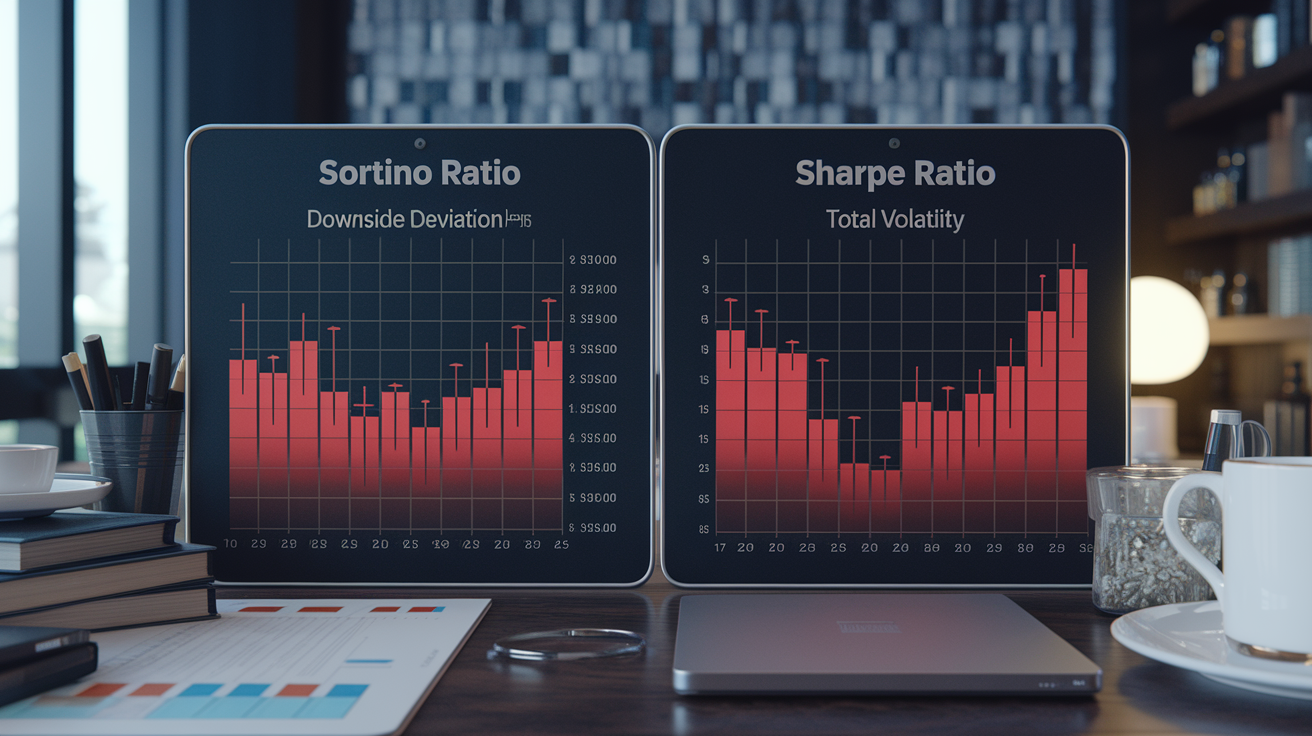
The Sharpe ratio divides excess return (portfolio return minus the risk-free rate) by total standard deviation. The Sortino ratio divides excess return (portfolio return minus MAR) by downside deviation. That single swap changes what you’re measuring and which strategies look attractive.
| Metric | What It Measures |
|---|---|
| Sharpe Ratio | Excess return per unit of total volatility (both upside and downside swings) |
| Sortino Ratio | Excess return per unit of downside volatility (only returns below MAR) |
| Upside Volatility | Sharpe penalizes it; Sortino ignores it |
| Best Use | Sharpe for symmetric returns; Sortino for strategies where downside protection matters more than smooth upside |
A fund with big upside months and small downside months will often show a higher Sortino than Sharpe, because Sharpe treats those large positive swings as risk. If you only care about avoiding losses below a target (common for retirees or near-term savers), the Sortino ratio gives you a clearer picture of whether a manager is controlling the risk that actually hurts you.
Advantages and Limitations

Understanding both the strengths and weaknesses helps you decide when to rely on the Sortino ratio and when to pair it with other metrics.
Advantage: Isolates harmful volatility. You stop penalizing funds for delivering strong months, which is exactly what most investors want.
Advantage: Better suited for asymmetric strategies. Options-heavy portfolios, tail-hedged funds, and return-smoothing strategies often look better on Sortino than Sharpe because their upside is choppy but their downside is controlled.
Advantage: Aligns with target-based goals. If you need 6% annual return to stay on track for retirement, setting MAR to 6% and measuring downside deviation around that number makes the metric directly relevant to your plan.
Limitation: Sensitive to MAR choice. Changing MAR from 0% to 5% can cut your Sortino ratio in half, even when the underlying returns haven’t changed. Report the MAR alongside the ratio so readers understand what threshold you’re using.
Limitation: Ignores total risk in certain contexts. For highly leveraged or exotic strategies, downside deviation alone may miss tail events or liquidity crises that show up in other risk measures like maximum drawdown or Value-at-Risk.
Limitation: Requires enough data. Small sample sizes (especially fewer than 36 monthly observations) produce unstable estimates. Outlier months can dominate the denominator and distort the ratio.
Worked Example Calculation

Assume you’re evaluating a mutual fund using 12 monthly returns. Your minimum acceptable return is 0% (you don’t want to lose money in any month). Here’s how to calculate the Sortino ratio:
List your monthly returns and identify negative ones. Example returns: 2%, −3%, 1%, 4%, −1%, 2%, 3%, 1%, −2%, 2%, 1%, 2%. The negative returns are −3%, −1%, and −2%.
Calculate the deviations below MAR. MAR is 0%, so the deviations are −3%, −1%, and −2%. Square each: (−0.03)² = 0.0009, (−0.01)² = 0.0001, (−0.02)² = 0.0004.
Average the squared deviations across all 12 months. Sum = 0.0009 + 0.0001 + 0.0004 = 0.0014. Divide by 12: 0.0014 ÷ 12 ≈ 0.000117.
Take the square root to get monthly downside deviation. sqrt(0.000117) ≈ 0.0108, or about 1.08% per month.
Compute the numerator. Average monthly return = (2 − 3 + 1 + 4 − 1 + 2 + 3 + 1 − 2 + 2 + 1 + 2) ÷ 12 = 12 ÷ 12 = 1.0% per month. Numerator = 1.0% − 0% = 1.0%. Sortino ratio = 1.0% ÷ 1.08% ≈ 0.93.
A Sortino of 0.93 sits in the acceptable range but below 1.0, signaling that the fund’s excess return relative to downside risk is modest. If you annualize these figures (average monthly return of 1.0% becomes roughly 12.68% compounded annually, and monthly downside deviation of 1.08% scales to about 3.74% annually, or 1.08% × √12), you’d calculate (12.68% − 0%) ÷ 3.74% ≈ 3.39, which looks much stronger. The choice of periodic versus annualized inputs matters, so keep your time basis consistent and report which you’re using.
Final Words
You now know how the Sortino ratio measures returns relative to downside risk and why that matters for real investing choices.
We unpacked the formula and its pieces and showed how to read common ranges. We compared Sortino to the Sharpe ratio, listed pros and cons, and walked through a worked example.
Use Sortino as a practical tool alongside other metrics and a clear plan. Small, steady steps now can lead to smoother results and more confidence later.
FAQ
Q: What is the meaning of Sortino and what does sortino mean in Italian?
A: The Sortino ratio measures risk‑adjusted returns by focusing only on downside volatility. As an Italian word, “Sortino” is typically a surname, not a standard vocabulary term.
Q: What Sortino ratio is good?
A: A good Sortino ratio is generally above 2.0 for strong risk‑adjusted returns; values above 1.0 are acceptable, while negative values mean returns fell below the chosen minimum acceptable return.
Q: What was Frank Sinatra’s favorite Italian restaurant?
A: Frank Sinatra’s favorite Italian restaurant was reportedly Patsy’s in New York City, where he was a regular and often dined with friends during his career.