


What if your fund could fight the IRS?
Tax-managed funds are mutual funds built to lower the taxes you pay on investment gains.
They aim for after-tax returns by using tax-aware moves like selling higher-cost lots first, harvesting losses, and holding longer to avoid capital-gains distributions.
The result is fewer surprise tax bills and more money left compounding in your account until you sell.
They work best in taxable brokerage accounts and for investors in higher tax brackets.
Understanding What Tax‑Managed Funds Are and How They Work

Tax-managed funds are mutual funds with a dual goal: chase returns while keeping your annual tax bill as low as possible. Traditional mutual funds focus on beating a benchmark or generating income. Tax-managed funds treat after-tax return as part of the core mission. Fund managers use tax-aware trading to keep your 1099-DIV form clean, often targeting zero in box 2a, the line that shows capital gains distributions.
Why does this matter? Every dollar paid out as a capital gain gets reported and taxed, even if you reinvest it immediately. Picture this: a fund distributes $1,000 in capital gains. You’re in the top federal bracket (20% long-term capital gains rate plus 3.8% Net Investment Income Tax). That’s a $238 tax bill. A tax-managed fund avoids that distribution, leaving $238 more in your account instead of with the IRS.
These funds use specific tax-lot accounting, strategic loss harvesting, and disciplined holding periods to keep taxable events low. Instead of paying taxes year after year on distributions you never asked for, you pay only when you choose to sell shares. You control the timing and size of your tax bill. This structure matters in taxable brokerage accounts, where every distribution counts. Inside tax-deferred retirement accounts like 401(k)s or IRAs, distributions don’t trigger immediate tax consequences, so the benefit disappears.
Key Tax-Efficiency Strategies Used Inside Tax‑Managed Funds

Tax-managed fund managers rely on four tactics to keep distributions low and shareholders’ tax bills under control.
First, specific-lot identification when selling shares. Instead of using first-in-first-out or average-cost methods, managers deliberately sell the shares with the highest cost basis first. Say a fund owns two lots of the same stock, one purchased at $100 per share and another at $80. The stock’s trading at $120, and the manager needs to trim the position. Selling the $100 lot produces only a $20 realized gain per share. Selling the $80 lot produces a $40 gain, doubling the taxable income passed to shareholders. One decision cuts the gain in half.
Second, active loss harvesting throughout the year. Managers sell positions that are down to realize losses that offset realized gains elsewhere in the portfolio. To avoid the wash-sale rule (which disallows a loss deduction if you repurchase “substantially identical” securities within 30 days before or after the sale), managers typically wait 31 days before buying the position back. That waiting period locks in the tax benefit while keeping the fund’s exposure broadly intact.
The other two strategies complete the toolkit. Gain harvesting in low-rate years: When market values rise and a fund holds big unrealized gains, managers may intentionally realize a portion of those gains in years when shareholders are likely in lower tax brackets. This steps up the cost basis and avoids a larger tax hit later. Gain harvesting can happen immediately because the wash-sale rule applies only to losses, not gains.
Avoiding unnecessary turnover: Tax-managed funds minimize trading that doesn’t serve a tax purpose. They hold positions longer to convert short-term gains (taxed at higher ordinary-income rates) into long-term gains (taxed at lower capital-gains rates) and defer recognition whenever possible. Low turnover reduces realized gains and keeps more capital compounding tax-free inside the fund.
How Tax‑Managed Funds Differ from Index Funds, ETFs, and Traditional Mutual Funds
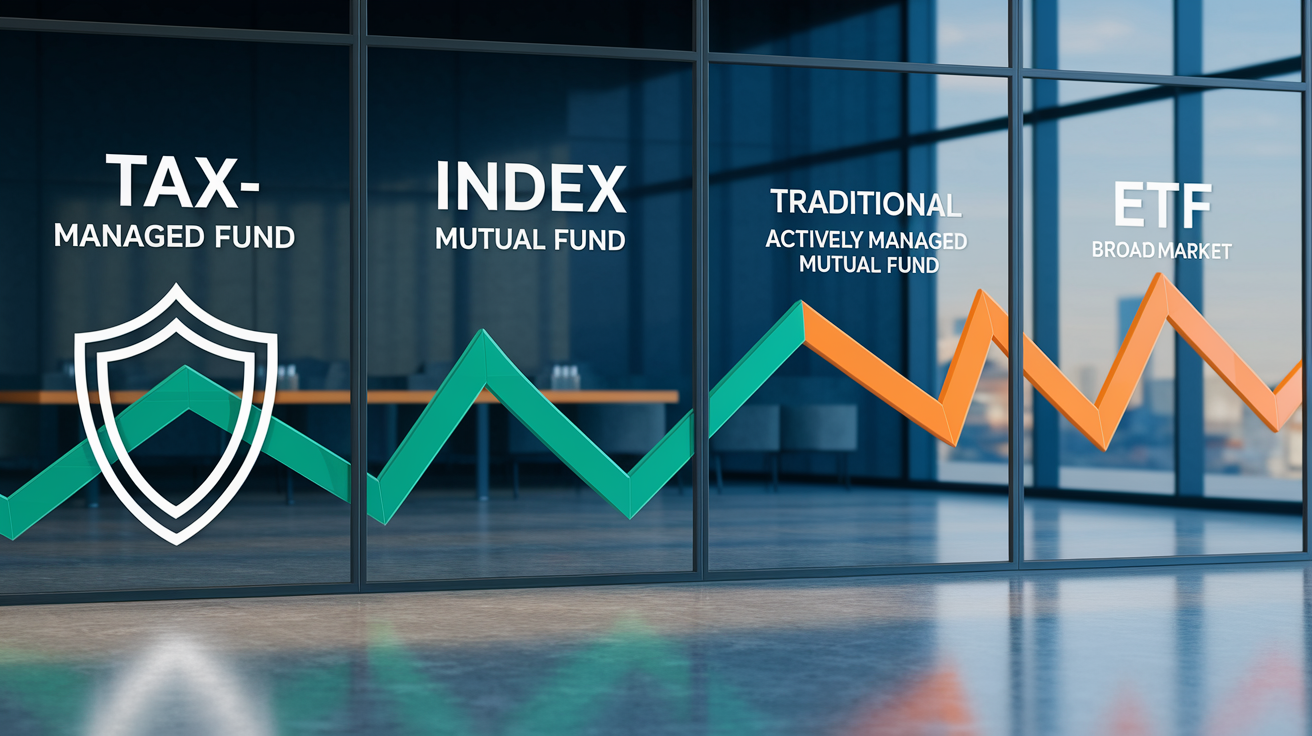
Tax-managed funds sit in a landscape crowded with other fund structures. Each has its own tax profile.
Traditional actively managed mutual funds prioritize investment performance without an explicit obligation to limit taxable events. Portfolio managers sell holdings to reposition the portfolio, upgrade to higher-conviction names, or manage risk, all without considering whether those trades create taxable distributions for shareholders. Traditional mutual funds often produce year-end capital gains distributions that investors can’t control.
Index mutual funds are naturally more tax-efficient because they trade infrequently. A pure market-cap-weighted index fund might turn over only 2% to 4% of its holdings annually as companies enter or exit the index. That low turnover keeps realized gains minimal. But index funds aren’t immune to taxable distributions. When an index reconstitutes (removing or adding stocks) or when large numbers of shareholders redeem their shares, the fund must sell holdings, potentially triggering gains. Index funds make no explicit promise to manage those events tax-efficiently. Low turnover is a byproduct of passive strategy, not a stated goal.
ETFs enjoy a structural tax advantage thanks to in-kind creation and redemption. When an ETF needs to meet redemptions, it can deliver a basket of securities directly to an authorized participant instead of selling them for cash. That exchange avoids a taxable sale inside the fund. Many broad-market equity ETFs have never paid a capital gains distribution. Still, not all ETFs are equally tax-efficient. Actively managed ETFs, currency-hedged ETFs, and certain bond or commodity ETFs can and do distribute gains. The in-kind mechanism is powerful but not a blanket guarantee.
| Fund Type | Typical Annual Turnover | Expected Tax Efficiency |
|---|---|---|
| Traditional Actively Managed Mutual Fund | 50%–100%+ | Low to Moderate |
| Index Mutual Fund | 2%–10% | Moderate to High |
| Tax-Managed Mutual Fund | 5%–20% | High |
| Broad-Market ETF | 2%–5% | Very High |
Tax-managed funds stand apart because they carry an explicit, written commitment to minimize taxable distributions. That commitment shows up in the prospectus, in fund marketing, and in the day-to-day decisions managers make about lot selection, loss harvesting, and turnover. If you’re investing in a taxable account and want predictable, low-distribution behavior, a tax-managed fund delivers that promise in writing.
Benefits and Drawbacks of Tax‑Managed Funds for Investors

The primary benefit is lower annual tax bills. Over time, that can translate into meaningfully higher after-tax wealth. Tax drag (the reduction in compounding caused by paying taxes on distributions) quietly erodes returns year after year. If a fund with 50% annual turnover generates 0.24% more in annual taxable events than a fund with 10% turnover, that extra drag compounds over decades. An investor starting with $100,000 and earning 8% annually might see several thousand dollars less in final account value simply due to the higher tax bill along the way. Tax-managed funds reduce that drag by keeping distributions near zero and deferring gains until you choose to sell.
You can measure tax efficiency using Morningstar’s tax-cost ratio, which estimates how much of a fund’s annualized return is lost to federal taxes on distributions. A fund with a 0.5% tax-cost ratio gives up half a percentage point of return to taxes each year compared to a hypothetical tax-free investor. Tax-managed funds typically show lower tax-cost ratios than their peers, translating directly into more money staying in your account.
But these funds come with trade-offs.
Potential for higher fees: Some tax-managed funds charge slightly higher expense ratios to cover the cost of more sophisticated tax-lot accounting and active loss harvesting.
Tracking error versus benchmarks: Tax considerations can prevent a manager from holding the optimal portfolio purely for pre-tax returns, leading to performance that diverges from an index or peer group.
Risk during large outflows or manager changes: If a fund experiences heavy redemptions or a new manager takes over and repositions the portfolio, the tax-management strategy can break down. That forces the realization of embedded gains and creates surprise distributions.
Federal-only focus: Tax-managed strategies target federal capital gains tax. They don’t address state taxes, alternative minimum tax, or the interaction of distributions with Social Security taxation or Medicare premium calculations.
Embedded gains can accumulate: After a long bull market, even a well-managed fund can carry large unrealized gains. If those gains eventually must be realized (due to redemptions, a strategy shift, or fund liquidation), shareholders can face a sizable tax bill all at once.
Not a substitute for comprehensive tax planning: A tax-managed fund is one tool, not a complete solution. Asset location (using IRAs and Roth accounts strategically) and coordinated gain/loss harvesting across your entire portfolio often matter more than fund-level tax management alone.
Who Should Consider Tax‑Managed Funds and When They Are Most Useful

Tax-managed funds make the most sense for investors holding assets in taxable brokerage accounts who expect to keep those investments for multiple years. If your money’s inside a traditional IRA, 401(k), or Roth IRA, the fund’s tax-management features provide little benefit. Those accounts already defer or eliminate taxes on internal fund activity. In a taxable account, though, every distribution you avoid is a tax bill you don’t pay, leaving more capital to compound.
These funds are especially useful for investors in higher federal tax brackets. If you’re subject to the 20% long-term capital gains rate plus the 3.8% Net Investment Income Tax (pushing your effective federal rate to 23.8%), avoiding a $10,000 capital gains distribution saves you $2,380 in federal taxes. For investors in the 15% bracket, that same $10,000 distribution costs $1,500. The higher your rate, the more valuable tax deferral becomes.
Tax-managed funds also appeal to investors and financial advisors who value predictability and control. Instead of bracing for a surprise year-end distribution that forces a tax payment you didn’t plan for, tax-managed funds let you decide when to realize gains by selling shares. That control is particularly valuable for retirees managing income thresholds (to avoid higher Medicare premiums or Social Security taxation) and for investors executing multi-year tax strategies like Roth conversions or charitable giving.
Key situations where tax-managed funds fit well:
Long-term taxable accounts where you plan to hold the investment for five years or more and want to minimize annual tax drag.
High-income investors already in the top capital gains brackets who benefit most from deferral and lower distribution rates.
Advisors building taxable portfolios for clients who need funds with predictable, low-distribution behavior to support tax planning and cash-flow management.
Investors who’ve already maxed out tax-advantaged space (401(k), IRA, HSA contributions) and are now investing additional savings in taxable brokerage accounts.
Simple Tax Examples Showing How Tax‑Managed Funds Reduce Tax Bills
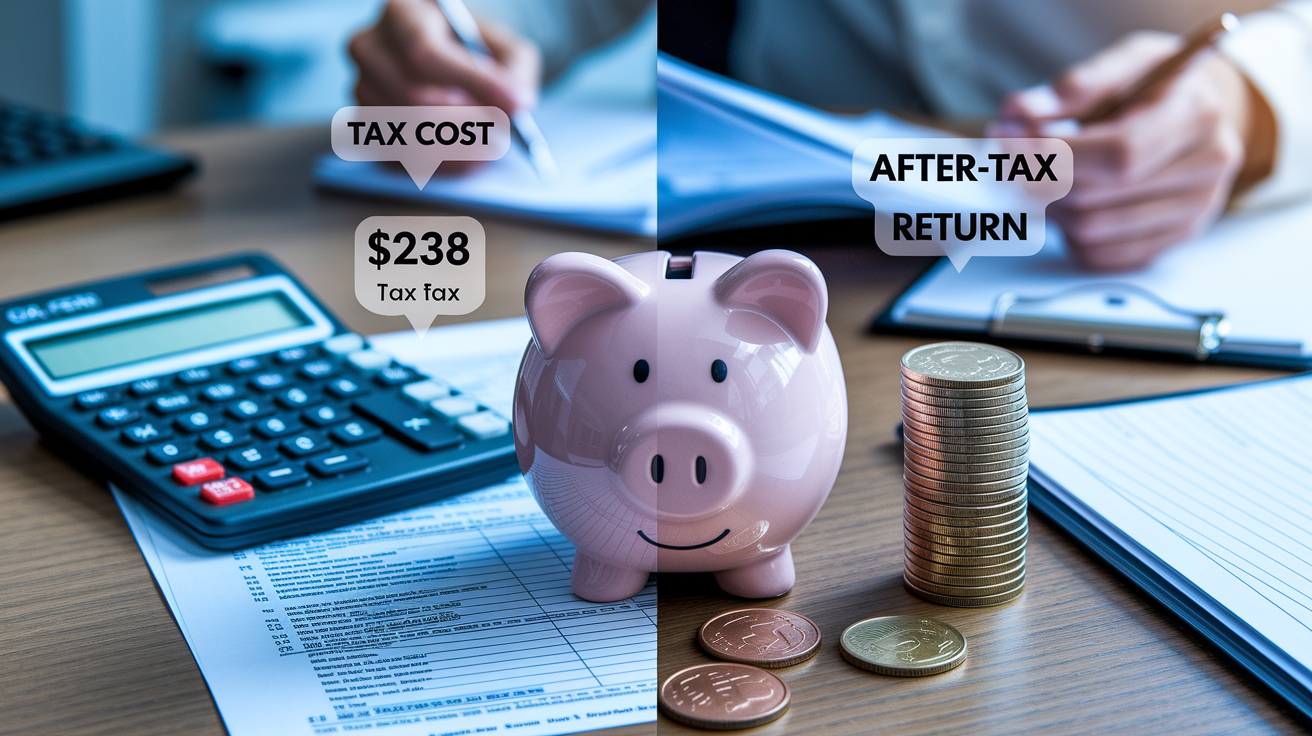
To see the practical impact, start with a straightforward distribution scenario. You own $100,000 in a mutual fund. At year-end, the fund distributes a $1,000 long-term capital gain (reported in box 2a of your 1099-DIV). You’re in the top federal bracket: 20% capital gains rate plus 3.8% Net Investment Income Tax. You owe $238 in federal taxes on that $1,000, even though you didn’t sell a single share. A tax-managed fund targeting $0 in box 2a avoids that distribution entirely, leaving you with $238 more in your account to reinvest and compound.
Now consider how lot selection changes realized gains inside the fund. The fund holds two lots of the same stock: Lot A purchased at $100 per share and Lot B purchased at $80 per share. The stock’s now trading at $120, and the manager needs to sell 100 shares to rebalance. Selling Lot A (the higher-cost-basis shares) produces a $20 gain per share, or $2,000 total. Selling Lot B produces a $40 gain per share, or $4,000 total. By choosing to sell Lot A, the manager cuts the realized gain in half. If that $2,000 difference were distributed to shareholders and taxed at 23.8%, it would cost investors $476 in federal taxes. Money that stays invested when the manager uses high-cost-basis lot selection.
A third example shows the compounding effect of avoiding distributions over time. Assume two otherwise identical funds: Fund X distributes 2% of its net asset value as capital gains each year, and Fund Y (a tax-managed fund) distributes 0%. Both earn 8% gross annual returns. For an investor in the 15% capital gains bracket, Fund X’s 2% distribution costs 0.30% in annual taxes (2% × 15%). Over 20 years, that 0.30% annual drag reduces the investor’s ending balance by roughly 6% compared to Fund Y, purely due to the compounding effect of paying taxes along the way instead of deferring them.
To calculate your own after-tax return for any fund, follow these steps:
Find the fund’s annual capital gains distribution as a percentage of NAV (often disclosed in the fund’s tax center or annual report).
Multiply that percentage by your marginal long-term capital gains tax rate to estimate the annual tax cost.
Subtract that tax cost from the fund’s total return to approximate your after-tax return, then compare it to a tax-managed alternative with lower or zero distributions.
How to Evaluate Tax‑Managed Funds Before Investing
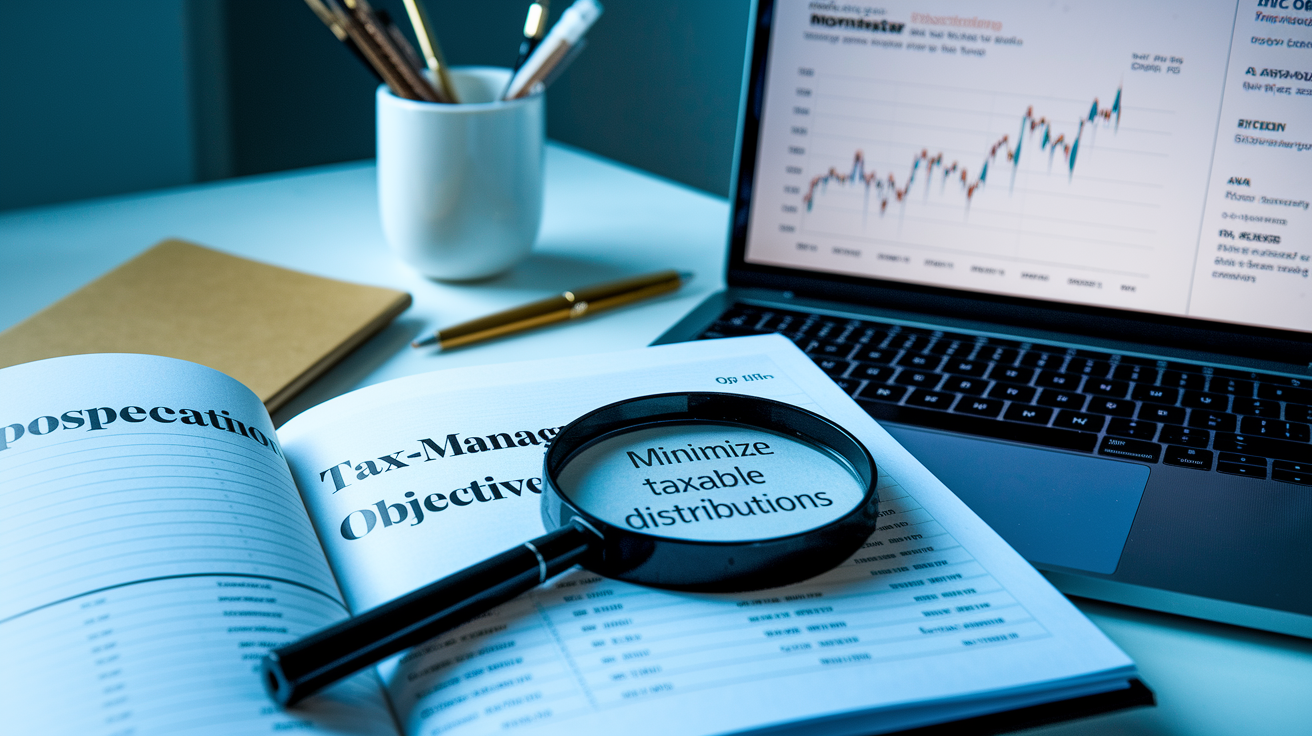
Before committing money to a tax-managed fund, verify that the fund’s prospectus explicitly mentions a tax-managed or tax-efficient objective. Look for language around minimizing taxable distributions or maximizing after-tax returns. Marketing materials can be vague. The prospectus is the legal document that commits the fund to its stated goals. If the prospectus doesn’t mention tax management, the fund isn’t obligated to prioritize it.
Next, review the fund’s historical distribution record. Most fund companies publish annual distribution histories showing capital gains, dividends, and return-of-capital amounts for the past five to ten years. Look for funds that have consistently reported $0 or near-$0 capital gains distributions, even during years when the market rose sharply. A fund that claims to be tax-managed but distributed gains in multiple recent years may lack the discipline or structure to deliver on its promise.
Check the fund’s embedded gains or unrealized appreciation. Some fund providers publish estimates of embedded gains as a percentage of net assets, often labeled “capital gain exposure” or “unrealized gain estimate.” A fund that’s delivered excellent returns over a long bull market can carry large embedded gains. If the fund experiences heavy redemptions or a manager change, those gains may be forced into realization, triggering a large taxable distribution even from a normally tax-efficient fund.
Use third-party metrics like Morningstar’s tax-cost ratio to compare funds. The tax-cost ratio estimates how much annualized return a fund loses to taxes on distributions. A fund with a 0.2% tax-cost ratio is losing less to taxes than a peer with a 0.8% ratio, all else equal.
Finally, assess fund management stability and operational factors.
Manager tenure: Frequent manager changes can disrupt tax-aware strategies and force portfolio repositioning that triggers gains.
Fund size and flows: Very large inflows or outflows can make tax management harder. Steady, moderate growth is ideal.
Expense ratio: Make sure the fund’s fees don’t offset the tax savings you’re gaining. A fund charging 0.75% to save you 0.30% in annual taxes is still a net win. A fund charging 1.5% may not be.
Turnover ratio: Even tax-managed funds trade. Look for turnover in the 5% to 20% range for equity funds. Much higher turnover suggests the tax-management process may be less disciplined.
Distribution policy and estimates: Some funds publish forward-looking capital gain estimates in November or December each year, giving you advance notice of any upcoming distributions so you can plan accordingly.
Final Words
You now know what tax-managed funds are and the common tax-savvy moves managers use. You also saw how they differ from ETFs, index funds, and traditional mutual funds, and when they’re most useful.
Use the simple examples and evaluation checklist in this post: check historical distributions, turnover, tax-cost ratios, and whether the fund is meant for taxable accounts.
With tax-managed funds explained, you’re ready to pick more tax-smart funds for your taxable accounts. Small steps now can mean bigger after-tax savings later.
FAQ
Q: How do tax-managed funds work?
A: Tax-managed funds work by prioritizing after-tax returns, using strategies like tax-loss harvesting, high-cost-basis lot selection, and careful trade timing to minimize taxable distributions and lower your annual tax bill.
Q: Does Dave Ramsey recommend actively managed funds?
A: Dave Ramsey recommends long-term, diversified mutual funds chosen as part of a financial plan; he discourages frequent trading, so active management is fine only if it fits your long-term strategy.
Q: What happens to my ELSS after 3 years?
A: After three years, your ELSS lock-in ends, so you can redeem or switch units; any gains are treated as long-term equity gains and taxed or reported according to current local rules.
Q: What loopholes do billionaires use to avoid taxes?
A: Billionaires use tax planning techniques like capital-gains timing, trusts, charitable giving, carried-interest rules, step-up in basis, and debt financing to legally reduce tax bills; some tactics are controversial and face scrutiny.