


Which is smarter for your savings: paying extra for a team of specialists or trusting one team to run everything?
Both can give you diversified exposure, but they work very differently.
A fund-of-funds buys other funds, handing you access to many specialist managers at the cost of layered fees and less transparency.
A multi-asset fund buys the actual stocks, bonds and alternatives itself, usually with lower fees and clearer holdings but with one team’s decisions.
This post shows when each choice makes sense, so you can pick the right one for your goals and budget.
Defining Fund‑of‑Funds and Multi‑Asset Funds: A Clear Comparison

A fund-of-funds is an investment vehicle that doesn’t buy stocks or bonds directly. Instead, it buys shares in other funds. Your money goes into a portfolio of funds, and each of those funds owns the actual securities. The manager’s job? Pick which funds to buy, decide how much to put in each one, and keep an eye on performance.
Multi-asset funds work differently. The manager invests straight into stocks, bonds, real estate, commodities, whatever. One team handles everything. They’re not selecting bond funds, they’re buying the bonds themselves. Not picking equity funds, picking the equities.
Quick breakdown:
- Structure: Fund-of-funds owns other funds. Multi-asset owns actual securities.
- Holdings: Fund-of-funds typically holds 8 to 50 underlying funds. Multi-asset usually owns 50 to 500 individual securities, plus maybe some derivatives and cash.
- Risk management: Fund-of-funds inherits whatever risk decisions all those underlying managers make. Multi-asset applies one unified approach.
- Manager role: Fund-of-funds manager is picking and allocating to other managers. Multi-asset manager is picking assets and securities directly.
- Liquidity: Both can offer daily liquidity, but with fund-of-funds you’re dependent on the terms of every single underlying fund.
These structural differences control everything else. Cost, transparency, taxes, how well it fits what you’re trying to do. Understanding what you’re actually buying is step one.
How Each Structure Delivers Diversification

Fund-of-funds spread your money across different managers and strategies. One underlying fund stumbles? The others cushion the blow. You get what people call “manager diversification.” Maybe you own a European equity fund, a U.S. bond fund, a commodities play, and an emerging markets fund, each run by a separate team.
But you’re still one layer removed from the real holdings. And when markets get stressed, correlations between those funds can suddenly converge. The diversification you thought you had can shrink fast.
Multi-asset funds mix asset classes and individual securities inside one portfolio. The manager can shift toward stocks when they look cheap, add inflation-linked bonds when inflation’s rising, cut back on shaky corporate debt. Since the team controls the actual holdings, they can fine-tune how much overlap exists and where concentration sits.
Downside? You’re betting on one team’s judgment across all those asset classes. If they lack depth or blow a big allocation call, there’s no backup layer of managers to save you.
| Diversification Feature | Fund‑of‑Funds Approach | Multi‑Asset Approach |
|---|---|---|
| Primary source of diversification | Multiple fund managers and strategies | Multiple asset classes and individual securities |
| Number of decision-makers | Many (one per underlying fund) | One investment team |
| Correlation control | Indirect (depends on underlying fund choices) | Direct (manager can adjust holdings and weightings) |
| Depth of holdings | Often hundreds to thousands of securities across all underlying funds | Typically 50–500 individual securities plus derivatives |
Comparing Cost Structures and Fee Layers
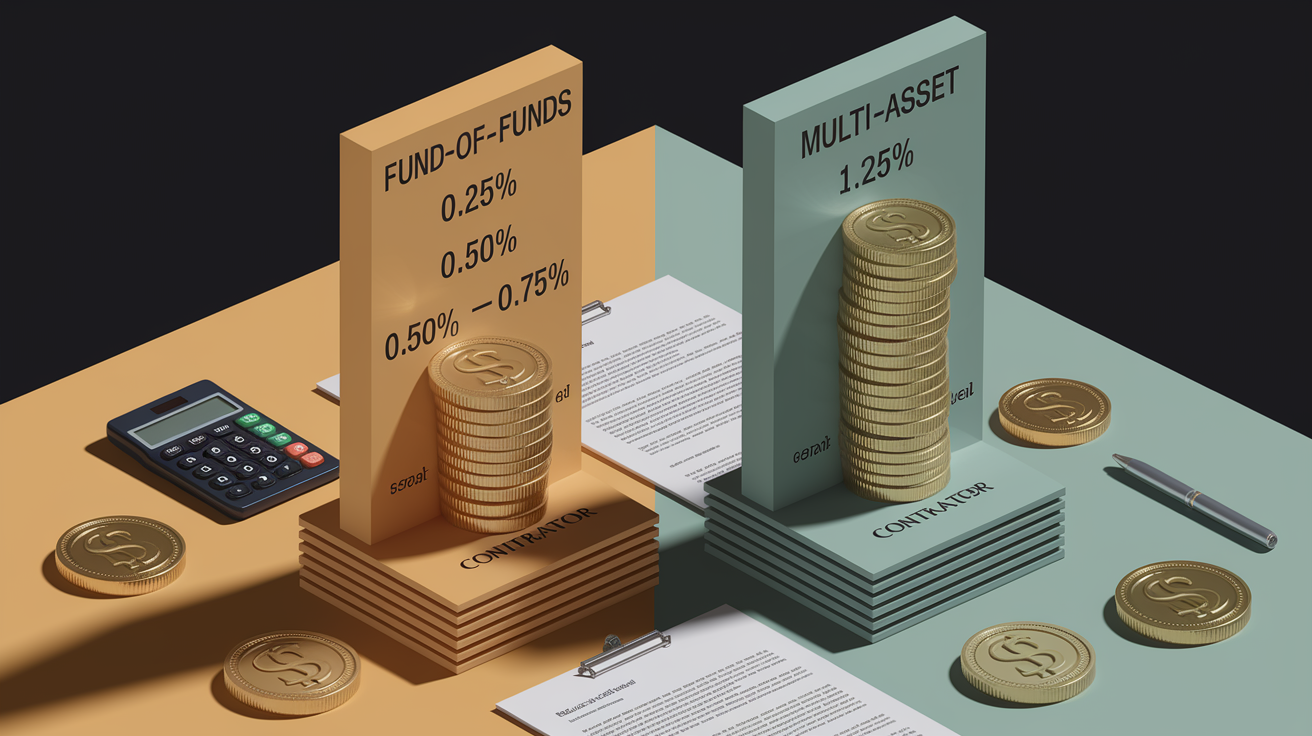
Fund-of-funds stack fees. The fund itself charges a management fee, usually somewhere between 0.25% and 1.00% a year. Then each underlying fund charges its own fee. If the top layer is 0.75% and the underlying funds average another 0.75%, you’re paying around 1.50% total. Add trading costs, performance fees, occasional entry or exit charges, and you can easily hit 1.8% annually. That’s a real drag over time.
Multi-asset funds charge one fee because there aren’t any underlying managers to pay. Typical range is 0.30% to 1.25% per year, all in. The manager executes trades directly. No double-dip. The fee you see in the documents is mostly what you pay, aside from small transaction costs.
Over ten years, an extra 0.7% in annual fees can cut your ending balance by roughly 7% to 10%, depending on returns and compounding. If you’re saving for retirement or your kid’s college, that’s real money staying in someone else’s pocket instead of yours.
When you’re evaluating cost, look at:
- Total expense ratio including every underlying fund fee, not just what the fund-of-funds charges on top.
- Performance fees or high-water marks on any underlying funds, which can tack on another 0.5% to 2% in good years.
- Platform or wrapper fees if you’re accessing the fund through an adviser or investment platform. That’s another layer.
Understanding Management Style and Decision Pathways

Fund-of-funds use a manager-of-managers model. The fund-of-funds manager picks specialist fund managers, then decides how much money goes to each. Market conditions change? They can shift allocations, add to one fund, trim another, swap out a manager. But they don’t control what happens inside each underlying fund. If an equity manager loads up on tech stocks or a bond manager extends duration, you inherit those calls whether you like them or not.
Multi-asset funds centralize everything under one team. That team sets asset allocation, picks securities, manages currency hedges, implements tactical overlays like volatility or inflation protection. Advantage? Speed and coherence. If the team spots a risk building, they can cut exposure immediately. No waiting for some underlying manager to act.
Disadvantage? All the decision-making sits with one group. Their macro view turns out wrong or their process breaks down? There’s no safety net.
Decision latency matters more than people realize. In a fund-of-funds, cutting equity exposure means selling units in an equity fund. That can take days to settle. And that equity manager might’ve already made allocation choices that don’t line up with your new view. In a multi-asset fund, the same decision can happen in hours through direct sales or derivatives.
For buy-and-hold investors, latency doesn’t matter much. For people who want active risk management or tactical tilts, multi-asset tends to be more responsive.
Pros and Cons of Each Investment Vehicle

Fund-of-Funds Pros:
Access to specialist managers and niche strategies you can’t easily get on your own. Manager diversification reduces reliance on any single team or research process. Outsources all the manager selection and due diligence work. You can combine different styles (value, growth, quant, thematic) in one wrapper.
Fund-of-Funds Cons:
Higher fees because of layered management charges and potential performance fees. Lower transparency into what securities you actually own, what sectors or countries you’re exposed to. Liquidity risk if any underlying fund puts up gates, lock-ups, or redemption restrictions. Potential for overlap or unintended concentration if underlying funds hold similar positions.
Multi-Asset Fund Pros:
Lower fees with no extra layer of underlying fund charges. Better transparency into actual holdings, asset allocation, risk exposures. Unified risk management and faster implementation when allocations need to change. More tax efficient because the manager controls trading and can manage capital gains and losses directly.
Multi-Asset Fund Cons:
You’re relying on one team’s skill across all asset classes. You might miss out on highly specialized strategies or alternatives only available through dedicated managers. If the team makes a broad macro mistake, there’s no underlying manager layer to offset it. Can become generalist without deep expertise in certain markets or instruments.
The trade-off is simple: pay more for diversified manager expertise and accept lower transparency plus higher fees, or pay less for centralized control and accept concentration of decision-making risk. Neither is automatically better. Depends what you value more.
Investor Suitability: Matching the Product to the Investor Profile

Fund-of-funds suit investors who want to delegate manager research and selection. Usually because they don’t have the time, expertise, or resources to vet multiple specialist managers themselves. High-net-worth individuals, family offices, institutional investors who value access to niche strategies (hedge funds, private credit, emerging market specialists) that aren’t easily replicated inside a single multi-asset fund.
If you’re investing seven figures and want exposure to six or eight highly specialized managers, a fund-of-funds can be an efficient wrapper. Provided the extra fees are justified by the access and returns.
Multi-asset funds fit cost-sensitive investors who care about transparency, simplicity, lower fees. Retail investors building a core allocation. Advisers constructing model portfolios for many clients. Retirement savers who want one diversified holding. If your goal is steady, diversified growth without paying for multiple layers of management, and you’re comfortable relying on one team’s process, multi-asset is usually cleaner.
Key indicators to check:
- Fee sensitivity: If every 0.5% of annual cost matters to your long-term outcome, go with a multi-asset fund charging under 1%.
- Access requirements: Need exposure to strategies or managers not available in a typical multi-asset fund? Consider fund-of-funds despite higher fees.
- Complexity tolerance: Want simple reporting, one NAV, straightforward tax documents? Choose multi-asset. Willing to accept multi-layered reporting for potential diversification benefits? Fund-of-funds might work.
Scenario‑Based Decision Framework

Scenario 1: Fee-sensitive investor with a 20-year time horizon
A 35-year-old saving for retirement wants diversified exposure to equities, bonds, alternatives. But costs matter because small fee differences compound hard over two decades. Multi-asset fund charging 0.40% to 0.70% per year fits best. Lower cost keeps more capital compounding. Transparency makes it easier to monitor allocation drift and tax efficiency. Fund-of-funds charging 1.5% or more would eat too much wealth over 20 years unless it consistently outperforms by a wide margin net of all fees.
Scenario 2: High-net-worth investor seeking access to specialist hedge and private credit strategies
Family office with a $5 million allocation wants exposure to long-short equity, event-driven credit, emerging market debt managed by top-tier specialists. These strategies aren’t typically available inside a retail multi-asset fund. Fund-of-funds makes sense here, even with a combined total expense ratio of 1.6% to 2.2%. The investor gets access to managers and strategies otherwise unavailable. Key is verifying that the fund-of-funds manager has a documented track record of selecting managers who deliver alpha net of the layered fees.
Scenario 3: Financial adviser building a core allocation for 50 clients
Adviser needs a single, simple, diversified holding that works across many client accounts with minimal admin burden. Multi-asset fund offers one NAV, one set of tax documents, straightforward reporting. Using fund-of-funds would multiply paperwork, create fee disclosure complexity, make performance attribution harder. Multi-asset is the better operational fit. Save fund-of-funds exposure (if any) for a small satellite sleeve where unique manager access adds clear value.
| Scenario | Best Fit | Primary Reason |
|---|---|---|
| Fee-sensitive long-term saver | Multi-asset fund | Lower total costs preserve compounding over decades |
| Investor needing specialist manager access | Fund-of-funds | Access to niche strategies and top-tier managers not available in MAF |
| Adviser managing many client accounts | Multi-asset fund | Operational simplicity, single NAV, easier reporting and compliance |
Final Words
We compared fund‑of‑funds and multi‑asset funds across definitions, diversification, fees, management style, pros and cons, investor fit, and a scenario-based decision framework. You can now see the practical differences that matter to your portfolio.
Use fees, needed specialization, and desire for simplicity as your tie-breakers. Follow the scenario steps and your time horizon.
Use the scenario guide to decide when to choose a fund-of-funds versus a multi-asset fund. Either choice can work. Stick to a clear plan and keep contributing.
FAQ
Q: What is Warren Buffett’s recommended asset allocation?
A: Warren Buffett’s recommended asset allocation is 90% in a low-cost S&P 500 index fund and 10% in short-term U.S. Treasury bonds, a simple default for long-term investors.
Q: What are the disadvantages of multi-asset funds?
A: The disadvantages of multi-asset funds are higher fees than plain index funds, limited specialist exposure, manager-concentration risk, and sometimes muted returns from conservative asset mixes. Check fees, holdings, and manager track record first.
Q: Is it good to invest in fund-of-funds (FoFs), and are FoFs suitable for beginners?
A: Investing in fund-of-funds (FoFs) can be a good choice, especially for beginners, because they offer ready diversification and manager selection, but watch higher fee layers and compare costs with simpler multi-asset or index options.