


Want bond income without watching your balance swing like a stock ticker?
Many chase yield and get surprised when rates rise or issuers struggle.
Choosing the right bond fund is about three tradeoffs: duration (sensitivity to rate moves), credit quality, and yield, plus fees.
This post gives a five-step checklist you can use in 10–20 minutes to match a fund to your income needs and risk comfort.
You’ll also get quick rules for diversifying across durations and fund types so your income keeps working when markets wobble.
How to Choose the Right Bond Funds (Quick Start)
Choosing a bond fund starts with matching your need for income and stability to what the fund actually does. Most investors want steady income without their account balance jumping around like a stock ticker. So the first call you need to make is how much interest rate sensitivity you can stomach, and how much credit risk you’re willing to take for a bit of extra yield.
Duration measures how much a bond fund’s price will move when interest rates change. Think of it as a sensitivity score in years. A fund with a duration of 5 will drop roughly 5% if rates rise by 1%. Credit quality tells you whether the issuers in the fund are likely to pay you back. Higher rated bonds (AAA to BBB) default less often but pay lower yields. Yield is the annual income the fund kicks off, expressed as a percentage of its price. Fees (expense ratios) are what you pay every year to own the fund. Lower is almost always better because fees eat directly into whatever you earn.
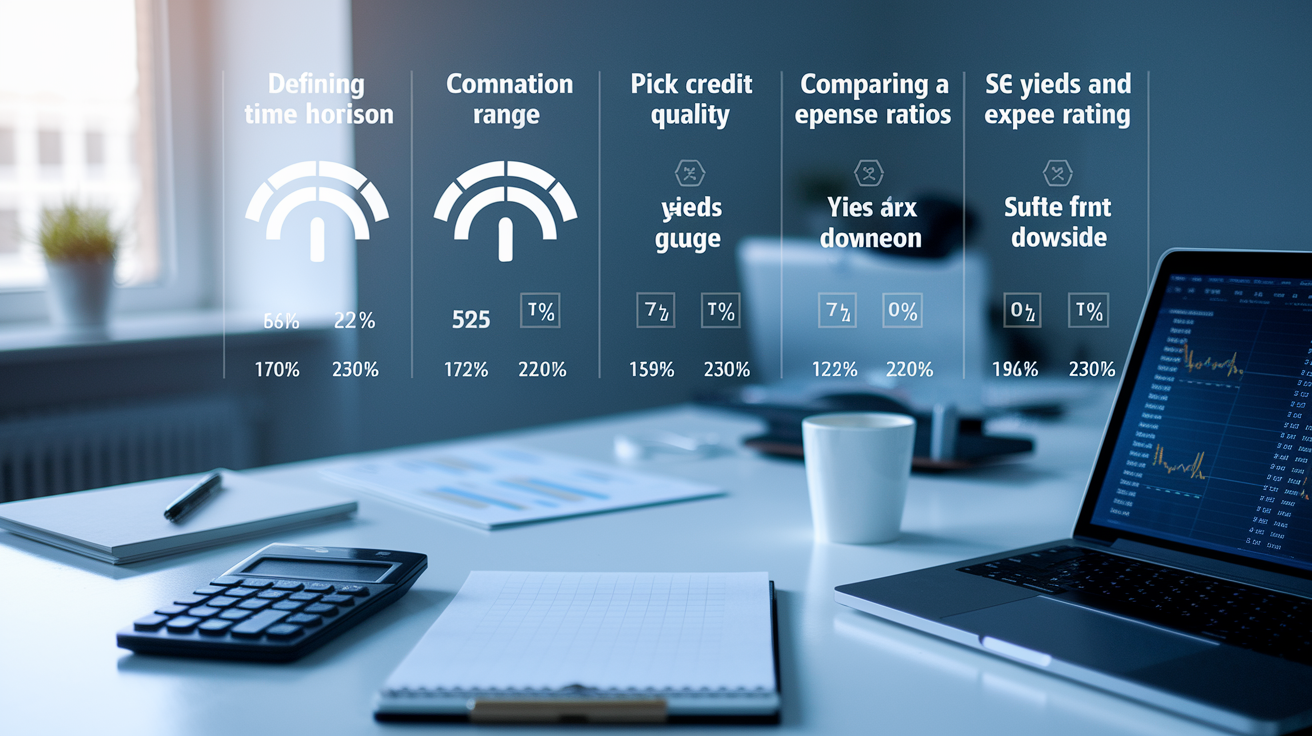
Here’s a five step workflow to pick a bond fund that fits:
-
Define your time horizon and income target. If you need cash in under three years, stick to short duration funds. For income over 5+ years, intermediate or long duration funds might make sense.
-
Choose a duration range. Match duration roughly to your investment horizon in years to keep interest rate risk manageable.
-
Pick your credit quality comfort zone. Decide whether you want the safety of government or investment grade bonds, or if you’re willing to accept high yield (junk) bonds for higher income.
-
Compare SEC yields and expense ratios. Use SEC yield for apples to apples income comparison. Aim for expense ratios under 0.30% for index funds and scrutinize anything above 0.50% for active funds.
-
Stress test the downside. Multiply the fund’s duration by 1% or 2% to estimate the price drop if rates jump, and confirm you can live with that potential loss.
Understanding Key Bond Fund Categories
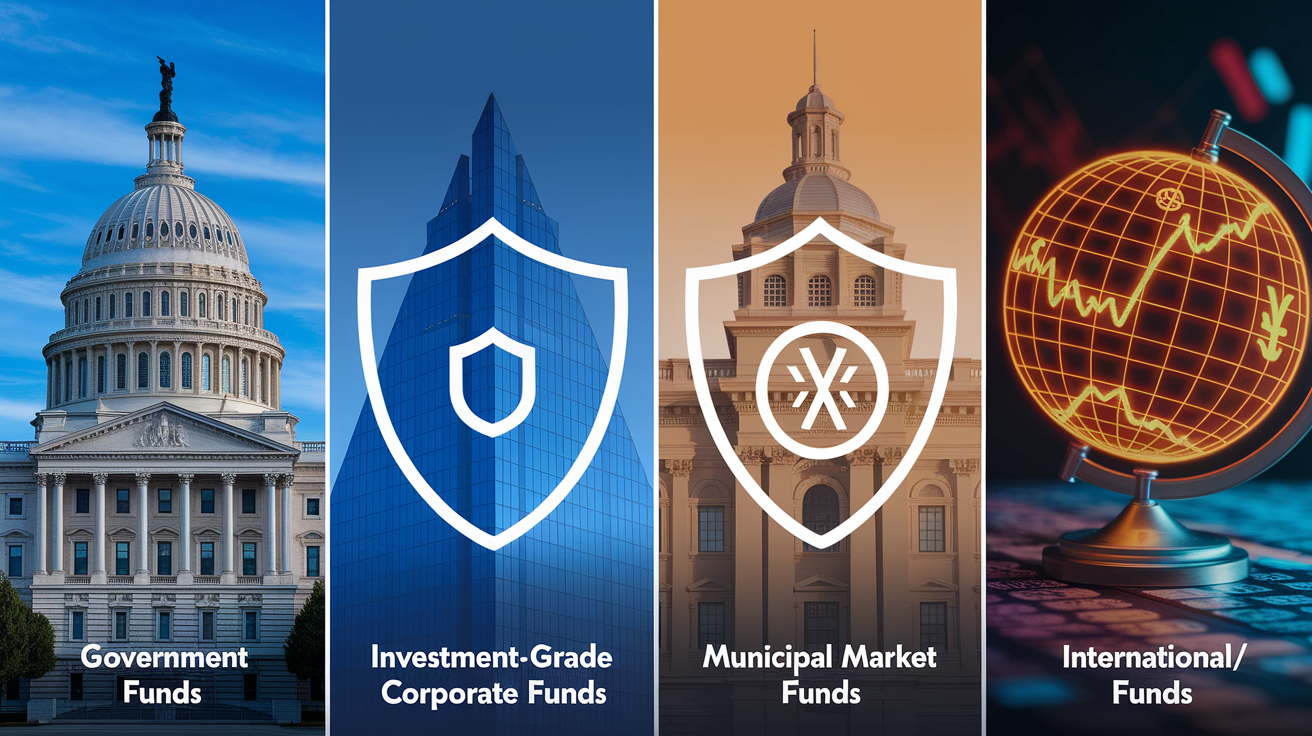
Bond funds come in several major categories, each offering a different blend of risk, income, and stability.
Government bond funds hold U.S. Treasuries or agency debt and sit at the safest end of the spectrum. They’re backed by the federal government, so credit risk is virtually zero. But yields are typically lower, often 1% to 4% depending on maturity. These funds work well for capital preservation and as a defensive anchor when markets get volatile.
Corporate bond funds invest in debt issued by companies, ranging from blue chip giants to smaller firms. Investment grade corporate funds (rated BBB– or higher) offer yields roughly 0.5% to 2% above comparable Treasuries, with moderate credit risk. High yield corporate funds (rated BB+ and below) can deliver 4.5% to 9% yields, but default risk and price volatility are significantly higher. Corporate funds make sense when you want more income than government bonds provide and you’re comfortable with the added credit exposure.
Municipal bond funds hold debt issued by state and local governments. Their income is often exempt from federal taxes, and sometimes state taxes if you buy a fund focused on your home state. Nominal yields may look modest (1% to 4.5%), but after tax yields can be competitive or even superior for investors in the 24% to 37% federal brackets. The tradeoff is liquidity. Munis can be less liquid than Treasuries, and credit quality varies by issuer.
International and emerging market bond funds expand geographic diversification and can offer yields from 3% to 8% or more, especially in emerging markets. The extra yield compensates for currency risk. Your returns depend not only on bond performance but also on exchange rate movements. These funds add diversification benefits but require comfort with political, economic, and currency volatility outside the U.S.
Here’s a quick summary of risk and yield tradeoffs by category:
Government funds: Lowest credit risk, lowest yields, best for stability.
Investment grade corporate funds: Moderate credit risk, moderate yields, balance of income and safety.
Municipal funds: Tax exempt income, moderate credit risk, best for high tax investors.
International/emerging market funds: Higher yields, currency and political risk, best for diversification seekers willing to accept volatility.
Evaluating Duration, Credit Quality, and Yield
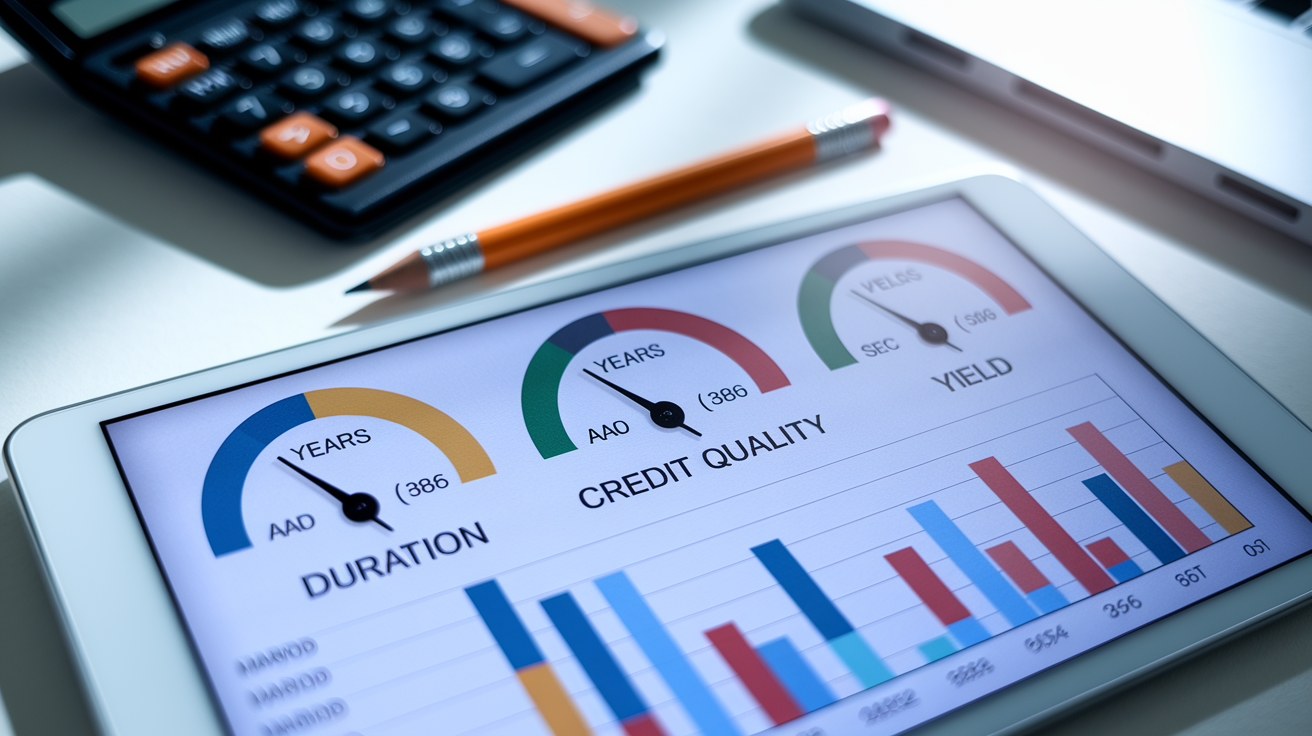
Duration is the single most important number for understanding how a bond fund will react to interest rate changes. It’s expressed in years, and the rule of thumb is simple: price change ≈ –Duration × change in yield. A fund with a duration of 7 will lose roughly 7% if rates rise by 1 percentage point, and gain roughly 7% if rates fall by the same amount.
Short duration funds (duration 0 to 3) offer stability but lower income. Long duration funds (duration 7+) deliver higher yields but swing harder when rates move. Match duration to your time horizon. If you need the money in three years, a duration of 3 keeps interest rate risk manageable.
Credit quality tells you how safe the bonds in the fund are from default. Ratings agencies assign letter grades: AAA, AA, A, and BBB are “investment grade,” meaning the issuer is considered likely to repay. BB and below are “high yield” or “junk,” where default risk is real and spreads (the extra yield over Treasuries) can widen sharply during stress. Check the fund’s average credit rating and the percentage of holdings below BBB.
If capital preservation matters, keep the bulk of your bond allocation in investment grade funds. If you’re chasing income and can stomach volatility, a small slice of high yield (5% to 20% of your total portfolio) can boost overall yield without taking over.
Yield measures the income a fund generates relative to its price. The most reliable number is SEC yield, a standardized snapshot of recent income that lets you compare funds directly. Yield to worst (YTW) is also useful for callable bonds. It shows the lowest yield you’d receive if issuers call bonds early. Don’t confuse distribution yield (what the fund paid out last year) with SEC yield. Distribution yield can be inflated by return of capital or one time events.
Higher yield almost always means you’re accepting longer duration, lower credit quality, or both. There’s no free lunch. Evaluate whether the extra income justifies the extra risk.
Always cross check yield, duration, and credit quality together. A fund offering 6% yield with a duration of 8 and 40% junk rated bonds is a very different animal from a 3% yield fund with duration 3 and all investment grade holdings. Know what you’re buying.
Building Diversification with Bond Funds

Diversification within your bond allocation reduces the chance that one issuer default, one interest rate spike, or one sector meltdown wipes out your income or principal. The simplest approach is to hold a broad aggregate bond fund that owns hundreds of issues across government, corporate, and mortgage backed securities. A single core fund can deliver instant diversification and is often the best starting point for investors who want simplicity and low cost.
Beyond a core holding, you can layer in satellite funds to fine tune exposure. Diversify across durations by splitting your bond sleeve into short term (duration 1–3), intermediate (duration 3–7), and long term (duration 7+) buckets. For example, allocate 30% to a short term government fund, 50% to an intermediate corporate index, and 20% to a long term Treasury fund. This smooths reinvestment risk. When bonds mature or rates shift, you’re not forced to reinvest everything at once.
Diversify across sectors by blending government, investment grade corporate, municipal, and a small slice of high yield or international debt. Each sector reacts differently to economic cycles, credit events, and rate moves.
Geographic diversification is less common in bond portfolios than equity portfolios, but international and emerging market bond funds can reduce U.S. centric concentration. They also introduce currency risk, so treat them as a satellite (10% to 20% of your bond sleeve) rather than a core position unless you have specific global income needs.
Here are three practical diversification strategies:
Duration layering: Hold funds at short, intermediate, and long maturities to balance rate sensitivity and reinvestment flexibility.
Sector spread: Combine government, corporate, and municipal funds to avoid over reliance on one issuer type or tax treatment.
Geographic mix: Add a modest allocation to international or emerging market debt for broader diversification and potential yield pickup.
Understanding Risk and Return Dynamics

Interest rate risk is the dominant risk in most bond funds. When rates rise, bond prices fall. The longer the duration, the steeper the drop. A fund with a duration of 5 faces roughly a 5% price decline if the 10 year Treasury yield jumps by 1 percentage point. In a rising rate environment, long duration funds can lose 10% or more in a single year, erasing multiple years of income. Conversely, if rates fall, those same funds deliver capital appreciation on top of yield.
The key is to size your duration exposure to match your tolerance for price swings and your time horizon.
Credit risk is the chance that issuers in the fund default or suffer downgrades, causing bond prices to fall and yields to spike. Investment grade funds carry lower credit risk because they hold bonds rated BBB– or higher. High yield funds pack more default risk. During recessions, spreads can widen by 200 to 400 basis points, hammering prices even if Treasury rates stay flat. If you hold high yield funds, keep the allocation small (5% to 20% of your portfolio) and be prepared for sharp drawdowns during credit stress.
Credit risk is partially diversified away by holding funds with hundreds of issuers, but systemic shocks (like 2008 or March 2020) can hit the entire high yield sector at once.
Reinvestment risk affects all bond investors but shows up differently in funds versus individual bonds. When a bond matures or pays a coupon, you must reinvest that cash. If rates have fallen, your new investment earns less. Bond funds handle reinvestment automatically, but the fund’s yield will drift lower in a declining rate world. Laddering across maturities or holding a mix of durations helps smooth this risk because you’re not forced to reinvest everything at the worst possible moment.
Liquidity risk emerges during market stress when bond trading slows and bid ask spreads widen. Some bond funds, especially those holding emerging market debt, lower rated corporates, or thinly traded munis, can see their net asset values drop sharply if investors rush for the exits and the manager must sell into an illiquid market.
Larger funds with diversified holdings and strong manager track records tend to handle liquidity shocks better. Check the fund’s size (prefer funds with at least $500 million to $1 billion in assets) and read recent commentary on trading conditions if you’re concerned about liquidity.
Tax Considerations for Bond Fund Investors
Taxable bond funds distribute interest income that is taxed as ordinary income at your marginal federal rate, which can be as high as 37%. If you hold taxable corporate or government bond funds in a taxable brokerage account, you’ll owe tax on every distribution, reducing your effective yield. For example, a 4% yield becomes 2.52% after tax if you’re in the 37% bracket.
Municipal bond funds offer a different deal. Their income is typically exempt from federal income tax, and if you buy a state specific muni fund and live in that state, you may also avoid state income tax. A muni fund yielding 3% can deliver a tax equivalent yield of 4.62% for an investor in the 35% federal bracket (formula: 3% ÷ (1 – 0.35) = 4.62%). Always compute the tax equivalent yield before deciding between taxable and muni funds. Municipal funds make the most sense for investors in the 24% bracket and above.
Account placement matters. Hold taxable bond funds (government, corporate, high yield) in tax deferred accounts like IRAs and 401(k)s whenever possible, so you defer or eliminate taxes on interest. Reserve tax exempt municipal funds for taxable accounts where their tax advantage pays off. If you’re forced to hold taxable bonds in a taxable account, favor short duration or Treasury funds, which generate less taxable income per dollar invested than high yield funds.
One quirk to watch: some municipal funds hold a small percentage of taxable bonds or private activity bonds subject to the alternative minimum tax (AMT). Check the fund’s tax profile if AMT applies to you, and confirm that the majority of income is truly tax exempt at the federal and state level.
Sample Portfolio Approaches Using Bond Funds
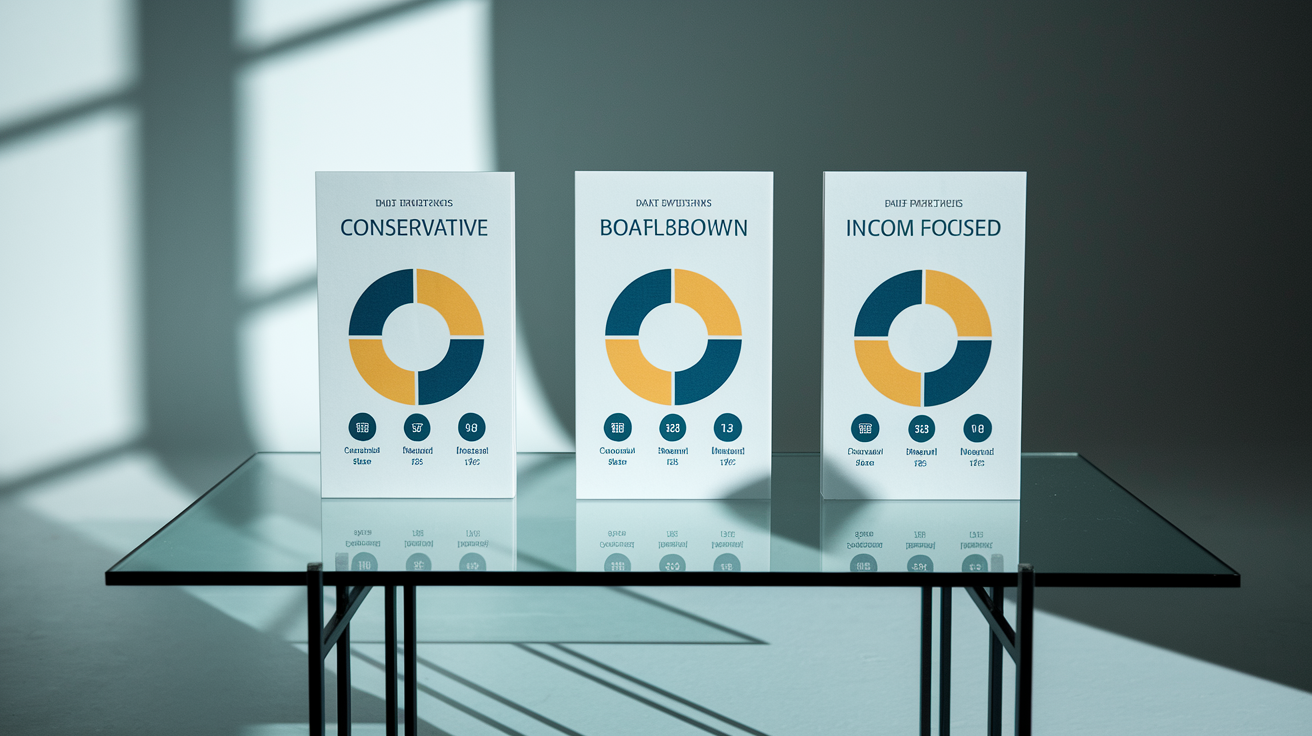
Different investment goals and risk tolerances call for different bond fund mixes. Here are three common portfolio archetypes showing how you might combine bond funds to meet specific objectives.
| Portfolio Type | Objective | Example Bond Fund Mix |
|---|---|---|
| Conservative | Preserve capital, minimize volatility, modest income | 60% short term government fund (duration 1–3), 40% core aggregate index (duration ~5) |
| Balanced | Balance income and stability, moderate rate sensitivity | 50% core aggregate index, 25% investment grade corporate, 15% municipal (if taxable account), 10% short term high yield |
| Income Focused | Maximize yield, accept higher volatility and credit risk | 30% high yield corporate, 30% emerging market debt, 20% intermediate investment grade corporate, 20% short term cash equivalent |
The conservative approach anchors heavily in short duration and government bonds, delivering stability and low interest rate risk. Yields will be lower, often 1% to 3%, but principal swings stay small even when rates move. This mix suits retirees who need predictable income and can’t afford a 10% drawdown, or investors saving for a near term goal.
The balanced portfolio blends a core aggregate fund with targeted credit and tax efficient exposure. The aggregate fund provides broad diversification. The investment grade corporate slice boosts yield modestly. The municipal allocation adds tax efficiency for high bracket investors. And a small high yield position (10%) nudges overall income higher without dominating the mix. Expected yield might range from 2.5% to 4.5%, with moderate sensitivity to rate moves (duration around 4 to 6 across the whole sleeve).
The income focused portfolio leans into higher yielding, higher risk categories. High yield corporate and emerging market debt can deliver 5% to 8% yields or more, but credit spreads can widen sharply during downturns. The intermediate corporate and short term cash positions provide ballast and liquidity. This mix suits investors with long time horizons, stable cash flow from other sources, and the emotional discipline to ride out 15% to 20% drawdowns in bond values during credit stress.
Always keep high yield and emerging market exposure under 25% of your total portfolio unless you have a very high risk tolerance and a clear plan for rebalancing.
Final Words
We walked through a practical, step-by-step method to pick bond funds: quick selection rules, major fund categories, and a five-step selection workflow.
You also learned how to read duration, credit quality, yield, and fees, plus simple ways to diversify by duration, sector, and geography, and how taxes change income.
If you’re asking how to choose bond funds for diversification and income, start with a low-cost, well-diversified fund and a small, repeatable process. It will make staying steady much easier.
FAQ
Q: How do I choose the right bond funds?
A: Choosing the right bond funds means checking duration (interest-rate sensitivity), credit quality, yield, fees, and diversification. Prefer short-term for less rate risk and long-term only if you want higher yield and accept more swing.
Q: What is duration and why does it matter?
A: Duration measures a bond fund’s sensitivity to interest-rate changes (interest-rate sensitivity). It matters because longer duration means bigger price swings, so match duration to your time horizon and comfort with volatility.
Q: What is credit quality and how should I use it?
A: Credit quality rates a fund’s bonds by default risk; higher grades like AAA mean safer principal. Use higher credit quality for preservation and lower grades for extra yield, accepting more default risk when you do.
Q: How do I balance yield versus risk in bond funds?
A: Balancing yield versus risk means choosing a mix where some funds give steady income and others offer higher yield with more risk. Start with safer core funds and add small high-yield slices only if you need income.
Q: What types of bond funds are available and their tradeoffs?
A: Types include government, corporate, municipal, and international funds. Government equals stability, corporate offers higher yield with credit risk, municipal may be tax-exempt, and international adds geographic and currency risk.
Q: How should I diversify within bond funds?
A: Diversifying within bond funds means spreading across durations, sectors, and geographies. Use short and long maturities, mix government with corporate, and add international exposure to reduce concentration risk.
Q: How are bond funds taxed?
A: Bond fund taxes depend on type: municipal fund income may be federal or state tax-exempt; taxable bond funds generate ordinary income tax and often offer higher yields to offset that tax hit.
Q: What risks should I watch in bond funds?
A: Key risks are interest-rate risk (longer duration means bigger moves), credit risk (defaults), and reinvestment risk (falling income). Watch fund duration, average credit rating, and how stable the yield looks.
Q: Can you give example bond fund allocations for different goals?
A: Example allocations: Conservative—70% short-term government, 30% short-term corporates. Balanced—40% government, 40% corporate, 20% municipal. Income-focused—30% government, 40% corporate, 30% high-yield.