


Think hedge fund tactics are only for the rich? Think again.
Liquid alternative funds wrap hedge-fund strategies into mutual funds and ETFs you can buy or sell daily.
They aim to give you diversification and downside protection by using shorts, derivatives (contracts tied to other assets), and trend trades.
But they bring higher fees, tricky strategies, and wide performance differences between managers.
This post explains what liquid alts do, why some investors add a 5%–15% slice to a portfolio, and the simple checks to use before you invest.
What Are Liquid Alternative Funds?

Liquid alternative funds are mutual funds or ETFs that borrow hedge fund tactics but let you cash out daily. Unlike regular mutual funds that just buy stocks or bonds and hold them, these funds short securities, trade derivatives, use leverage, and chase arbitrage opportunities to find returns that don’t follow the stock market lockstep. The “liquid” part? You can sell any business day at net asset value, or trade throughout the day if it’s an ETF.
These took off after 2008, when people got tired of watching their portfolios crater in perfect sync with the S&P 500. Traditional hedge funds want a million bucks minimum and only let you pull money out quarterly, sometimes yearly. Liquid alts wrap similar strategies into SEC-registered funds with $1,000 to $10,000 minimums for mutual funds and basically no minimum for ETFs. Suddenly hedge fund moves became something normal investors could actually access.
What separates liquid alts from plain mutual funds is the mandate to hunt non-traditional returns: alpha from picking winners, spreads from merger deals, trends across commodity markets. What separates them from actual hedge funds is regulation, transparency, and the ability to exit. Liquid alts follow the Investment Company Act of 1940, which caps leverage, requires custody safeguards, and forces disclosure. You get daily pricing, detailed holdings reports, and settlement that’s now T+1 as of May 28, 2024.
Core Features and Structure of Liquid Alternative Funds

These funds run on the same legal framework as regular mutual funds and ETFs. Federal oversight, mandatory portfolio disclosures, strict custody rules. That structure gives you protections hedge funds don’t bother with. But liquid alts also use exemptions that allow limited shorting, derivatives exposure, and modest leverage, tools normally reserved for hedge funds.
Transparency’s another big piece. Mutual fund versions publish full portfolios quarterly. ETFs often show daily holdings. You can see exactly what the manager owns, which derivatives they’re using, how much leverage they’ve applied. That visibility helps you check whether a fund’s actual behavior lines up with what it claims to do.
Here’s what you’re typically looking at:
- Expense ratios usually between 0.50% and 2.50% annually, clustering around 0.75% to 1.50%
- Minimum investments of roughly $1,000 to $10,000 for mutual funds, often waived in advisory accounts, $0 for ETFs
- Daily NAV calculation and redemption for mutual funds, intraday trading for ETFs
- Regulated wrappers under the Investment Company Act of 1940, with leverage caps and liquidity rules
- Transparent reporting of holdings, exposures, and performance at least quarterly, sometimes monthly
Common Strategies Used in Liquid Alternative Funds

Liquid alternative funds use a bunch of hedge fund tactics designed to capture returns that don’t depend on stocks or bonds doing well. Most strategies fit into a few buckets, each with its own risk profile.
Long/Short Equity
Buy stocks you expect to rise, short stocks you expect to fall, and profit from being right on both sides. A typical fund might hold 120% long positions and 50% short, giving it 70% net equity exposure and 170% gross exposure. The short book cushions downside when markets drop, but performance still tends to move with equities. In strong bull markets, those short positions drag.
Managed Futures (CTA)
Managed futures funds use trend-following models to trade futures contracts across commodities, currencies, interest rates, and equity indices. When a trend shows up, crude oil climbing or the dollar strengthening, the fund takes a position and rides it until signals reverse. Historically these have delivered positive returns during sharp equity drops, like 2008 and early 2020, because crises often create strong trends in risk-off assets.
Market Neutral
Market neutral strategies balance long and short positions so overall equity exposure is near zero. The goal’s pure security-selection alpha, removing broad market risk. These funds usually show lower volatility than equities but also lower absolute returns, and they’re sensitive to stock correlations. When most stocks move together, security selection gets harder.
Global Macro
Global macro funds make directional bets across asset classes based on top-down economic and policy views. A manager might go long emerging market bonds expecting rate cuts, short a currency anticipating central bank intervention, or buy commodity futures ahead of supply shocks. Performance depends heavily on whether macro calls pan out. Results can be lumpy.
Event-Driven and Merger Arbitrage
Event-driven funds profit from corporate events like mergers, bankruptcies, spinoffs, restructurings. Merger arbitrage, the most common subset, involves buying the target company’s stock and sometimes shorting the acquirer’s stock, capturing the spread between the deal price and current market price. These tend to perform steadily in calm markets but can lose money if deals break or regulators step in.
Multi-Strategy
Multi-strategy funds combine several approaches, allocating capital dynamically across long/short equity, event-driven, relative value, and macro tactics. Diversification across strategies can smooth returns, but it adds complexity and makes it harder to understand what’s actually driving performance.
| Strategy | Core Objective |
|---|---|
| Long/Short Equity | Capture alpha from stock selection while managing net equity exposure |
| Managed Futures | Follow trends across futures markets to profit in various environments |
| Market Neutral | Deliver low volatility, low beta returns from security selection |
| Global Macro | Make directional bets on currencies, rates, and commodities based on macro views |
| Event-Driven | Profit from corporate events like mergers, bankruptcies, and restructurings |
| Multi-Strategy | Diversify across multiple alternative approaches to smooth returns |
Benefits of Liquid Alternative Funds

The main appeal is diversification beyond the standard stock and bond mix. Many strategies show low to moderate correlation with equities, often in the 0.0 to 0.3 range for managed futures or market neutral funds. They can behave differently when stocks fall. Adding even a modest 5% to 15% slice of low-correlation exposure can materially change a portfolio’s risk profile, reducing overall volatility and cushioning drawdowns without sacrificing too much long-term return potential.
Downside protection is another draw, especially for strategies like managed futures and certain long/short equity approaches. During 2008 and March 2020, some managed futures funds posted positive returns while equities tanked, providing a real hedge when it mattered. Market neutral and event-driven funds also tend to suffer smaller losses than long-only equity funds during corrections, though performance varies widely by manager.
Daily liquidity and accessibility make these funds practical for a much broader audience than traditional hedge funds. You don’t need $1 million, a two-year lock-up, or quarterly redemption windows. You can add a liquid alternative fund to a portfolio on Monday and sell it Friday if it doesn’t fit. That flexibility works for tactical adjustments and for investors who want hedge fund style exposure without giving up control of their capital. Lower minimums and transparent, regulated structures also mean better alignment with retail investors’ needs and regulatory protections hedge funds don’t provide.
Risks and Limitations to Consider

Complexity is the first hurdle. Liquid alternative funds use derivatives like futures, options, and swaps. They employ short positions and sometimes apply leverage. Understanding what a fund actually owns and how those positions will behave under stress requires digging into prospectuses, fact sheets, and monthly commentaries. Many investors glance at a fund’s name, “Market Neutral” or “Long/Short,” and assume they understand the risk. Reality’s often murkier. A fund might be market neutral on paper but take concentrated sector bets or use leverage that amplifies volatility.
Performance variability across managers is another major risk. Unlike passive index funds, where most products tracking the S&P 500 deliver nearly identical results, liquid alternative funds show enormous dispersion. One managed futures fund might gain 15% during an equity drawdown while another loses 5%, even though both claim the same strategy. Manager skill, implementation, leverage choices, and position sizing all matter. There’s no guarantee past outperformance will continue. Many funds also lack long track records. A three-year history doesn’t capture a full market cycle, making it hard to judge true skill versus luck.
Key risk categories to watch:
- Fee drag: Expense ratios of 0.75% to 2.50% annually, plus potential performance fees of 10% to 20% of gains, can erode net returns over time
- Strategy risk: Tactics like shorting or trend-following can underperform for extended periods, especially in sideways or steadily rising markets
- Liquidity risk: Although funds offer daily redemptions, underlying positions in swaps or illiquid securities can create mismatches. Funds may impose gates or suspend redemptions in stress
- Manager selection risk: Picking the wrong fund or strategy means you pay high fees for little or negative diversification benefit
Tax inefficiency adds another wrinkle for taxable investors. Active trading, short positions, and derivatives often generate short-term capital gains taxed at ordinary income rates. Some strategies produce ordinary income rather than long-term gains. ETF wrappers can be more tax efficient than mutual funds, but the benefit depends on the specific structure and turnover. Always model the after-tax return before committing capital in a taxable account.
Examples of Liquid Alternative Fund Types
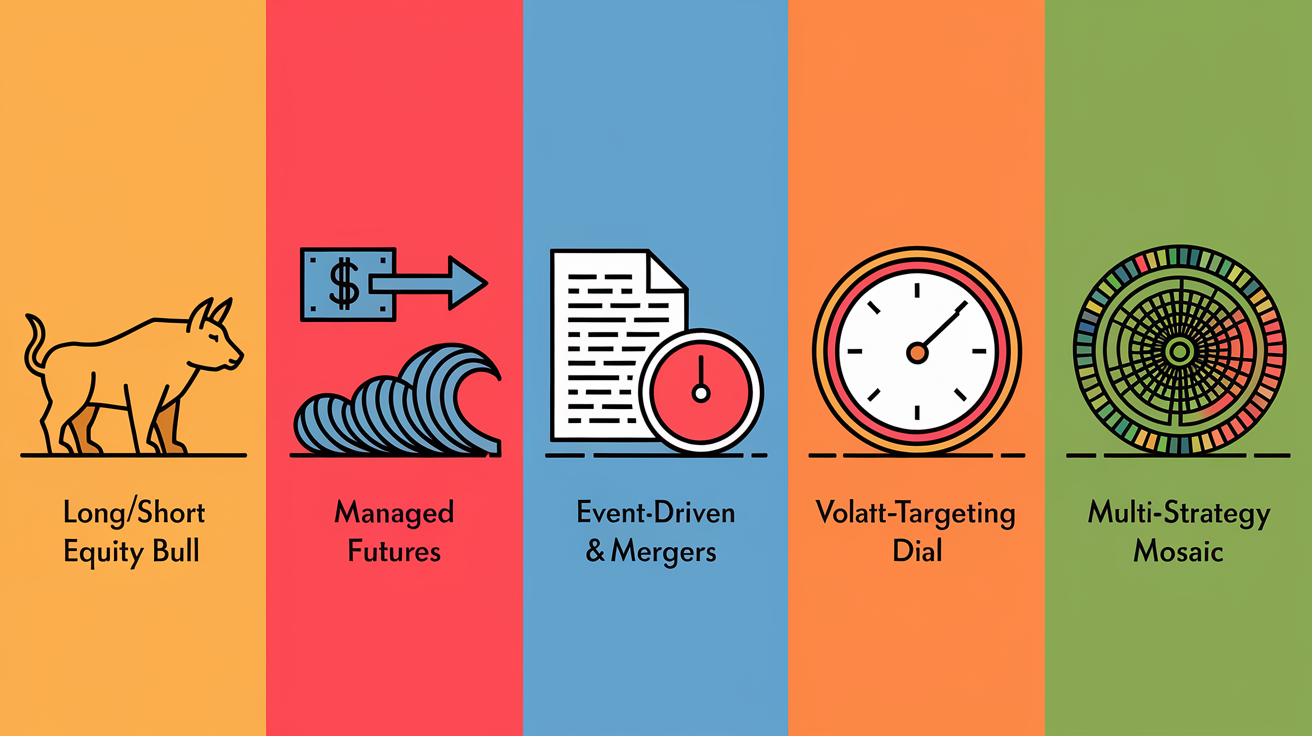
Liquid alternative funds come in many shapes, each targeting a specific risk-return profile or market niche. Here are five common categories:
- Long/short equity funds: Hold both long and short stock positions, often with net exposures ranging from 30% to 70% and gross exposures up to 200%, aiming to reduce market sensitivity while capturing alpha
- Managed futures funds: Use systematic trend-following models to trade commodity, currency, rate, and equity index futures, historically performing well during sharp equity sell-offs
- Event-driven funds: Focus on corporate events like mergers, spinoffs, and restructurings, seeking to capture deal spreads and special-situation opportunities with moderate volatility
- Volatility-targeting ETFs: Dynamically adjust equity exposure to maintain a target volatility level, often around 10% to 15% annualized, providing built-in downside management
- Multi-strategy mutual funds: Combine multiple alternative approaches, long/short, event-driven, relative value, under one roof, offering diversification across tactics and managers
Determining Whether Liquid Alternative Funds Suit Your Portfolio

Suitability starts with understanding your goals. If you’re looking to reduce portfolio volatility, add a non-correlated return stream, or build in some downside protection without locking up capital, liquid alternatives can make sense. But if your primary objective is long-term growth and you’re comfortable riding out equity drawdowns, a simpler mix of low-cost stock and bond index funds will likely serve you better. Liquid alts aren’t core holdings for most investors. They’re satellites designed to improve diversification or manage specific risks.
Your investment time horizon and cost sensitivity also matter. These funds need at least three to five years to demonstrate whether the strategy and manager can deliver on their objectives. Shorter holding periods increase the chance you’ll exit at the wrong time or pay high fees for noise rather than skill. On the cost side, if you’re fee-conscious and already achieving adequate diversification with low-cost funds, adding a 1.5% expense ratio alternative fund may not be worth the trade-off. Run the numbers on how much fee drag you’re willing to accept for the diversification or downside benefit you expect.
Consider your overall portfolio allocation and risk budget. Many advisors suggest limiting liquid alternatives to 5% to 15% of a diversified portfolio, with conservative investors leaning toward the lower end and those seeking more aggressive diversification moving toward the higher end. Beyond 20%, you’re betting heavily on manager skill and strategy persistence, which introduces concentrated risk. Start small, perhaps 3% to 5%. Monitor performance and correlation over 12 to 36 months. Scale up only if the fund delivers the diversification or protection you’re paying for. Require transparent reporting, a clear strategy mandate, and a track record that includes at least one stress period before committing significant capital.
Final Words
Focus on the essentials: we defined what liquid alternative funds are, walked through core features, common strategies, benefits, risks, and how to decide if they fit your plan.
Keep it practical. Check fees, understand strategy complexity, and start with a small allocation you can live with. Read the prospectus and favor managers with steady records.
Think of this post as “liquid alternative funds explained benefits and risks”, a plain guide to help you diversify calmly and act with confidence.
FAQ
Q: What are the benefits of liquid alternatives?
A: The benefits of liquid alternatives include daily liquidity, access to hedge‑fund‑style strategies at lower minimums and fees, plus potential diversification and downside protection that can smooth overall portfolio returns.
Q: What is the 15 * 15 * 15 rule?
A: The 15 * 15 * 15 rule is a shorthand that can mean different things depending on context; it’s not a universal investing rule—check the source or adviser for the exact definition before applying.
Q: What are the disadvantages of liquid funds and what is the downside of alternative investments?
A: The disadvantages of liquid funds and the downside of alternative investments are higher fees than plain funds, complex strategies, inconsistent returns across managers, and possible liquidity mismatches during market stress.