


Did you know the same mutual fund can come in versions that charge very different fees?
That choice matters.
A 1% annual fee gap can shave hundreds of thousands off a 40-year retirement balance.
We’ll walk through Class A, B, and C shares, show where costs come from, and compare long-term impacts in plain terms.
By the end you’ll know which share class usually costs less for small accounts, large lump sums, and retirement plans, and the quick rule to pick the cheaper option.
Key Differences Between Mutual Fund Share Classes

Mutual fund companies sell multiple versions of the same fund, each with different fees attached. The portfolio’s the same. The cost structure isn’t.
Class A, B, and C shares are what most retail investors run into. They hold identical investments but charge you in completely different ways. And those differences? They stack up fast.
Class A hits you upfront with a sales charge but keeps ongoing fees lower. Class B skips the initial bite, charges more every year, and penalizes you if you bail early. Class C lets you in without an upfront fee but sticks you with the highest annual costs, year after year.
Take the Growth Fund of America. It’s got $310 billion in assets and offers 19 share classes. Most people only see three options. Your pick determines how much money actually goes to work, what you pay annually, and what’s left after ten or twenty years.
Here’s how the classes break down:
Class A takes a front load, usually around 5.75% before any discounts kick in. Ongoing costs run lower, often 0.60% to 0.90%. The 12b-1 fee is minimal or zero. Bigger investments unlock breakpoints at $50,000, $100,000, $250,000, and up. Each tier cuts the front load.
Class B doesn’t charge upfront. Instead, you get a contingent deferred sales charge if you sell early, often starting at 5% and dropping to zero over six to eight years. The 12b-1 fee runs high, historically near 1.00%. After the penalty window closes, most B shares convert to A shares automatically.
Class C skips the front load. Some funds tack on a 1% fee if you sell within a year. Annual expenses run high, usually 1.15% to 1.50%, driven by elevated 12b-1 fees. C shares don’t convert to anything cheaper. You’re stuck with that cost structure.
Ongoing fees eat into your returns every single year. A 1.00% annual difference can shave hundreds of thousands off a retirement account over 40 years. Front loads hurt most when you sell quickly. High annual fees hurt most when you hold long. Breakpoints and waivers can lower or eliminate sales charges if you’re investing larger amounts or using certain accounts like 401(k)s or 529 plans.
Class A Shares Explained

Class A shares charge a front load. A chunk of your money gets skimmed before anything’s invested. A typical retail load sits around 5.75%. Put in $10,000, and $9,425 goes to work.
But here’s the upside. Class A shares usually carry the lowest ongoing costs among retail classes. You might pay 0.75% annually instead of 1.25% or more with Class C.
Breakpoints cut the sting. Invest $50,000 and the front load might drop to 4.50%. At $100,000, maybe 3.75%. At $250,000, possibly 2.50%. Hit $1 million and many funds waive the load entirely. Each fund sets its own schedule, so ask for it. You can often combine household accounts to reach breakpoints faster.
Class A makes sense when you qualify for real breakpoint discounts and plan to stick around. Lower annual fees eventually make up for the upfront cost. Drop $100,000 with a 3.75% load and 0.75% expense ratio, and it can beat a no-load fund charging 1.25% annually after about 15 to 20 years, assuming returns match.
Class B Shares Explained
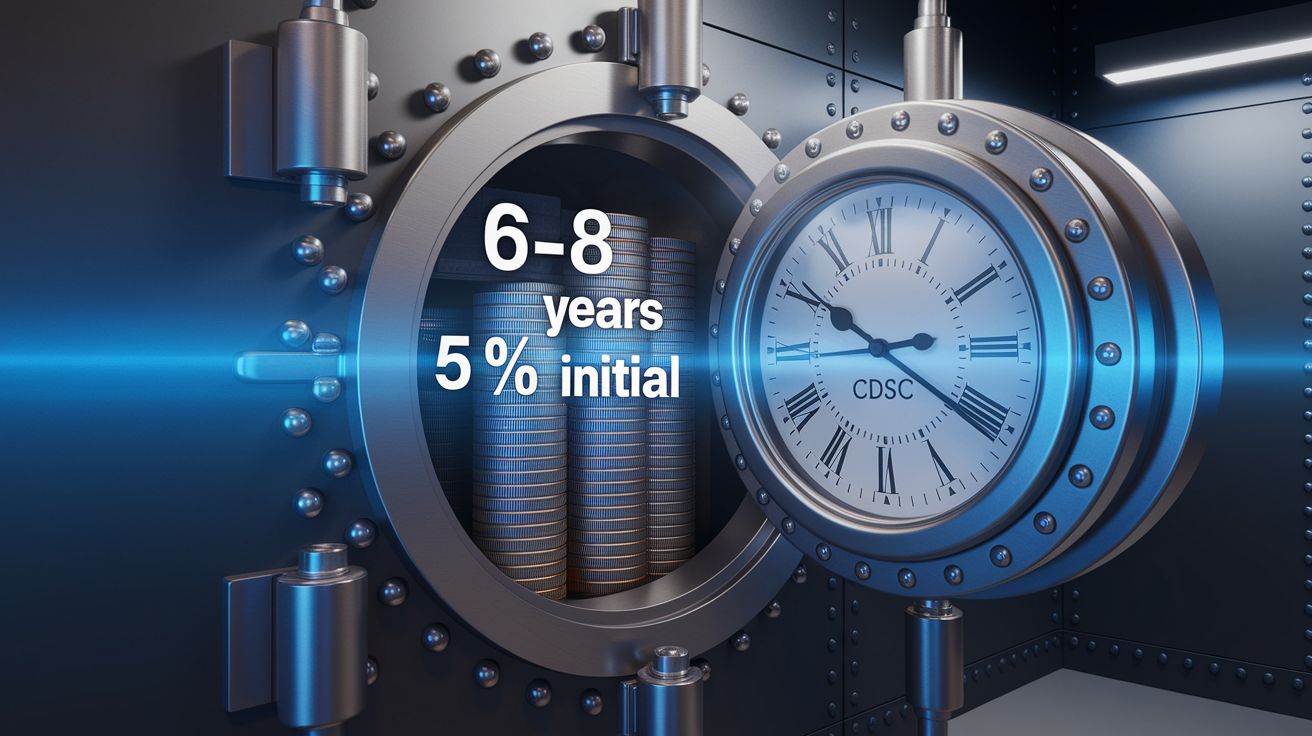
Class B flips the model. No upfront charge, but you get hit with a contingent deferred sales charge if you sell early. The CDSC usually starts at 5% and drops one percentage point each year until it zeroes out, often after six or eight years.
While that clock’s ticking, Class B charges higher annual 12b-1 fees. Historically around 1.00%, compared to 0.25% or nothing for Class A. That cost drags every year.
Once the penalty window closes, many B shares convert to A shares. Your annual expenses drop. But until that happens, you’re paying more.
Class B was pitched to smaller investors who couldn’t hit Class A breakpoints and planned to hold through conversion. In reality, it’s usually more expensive. High annual fees plus an exit penalty? Not a great combo.
Most fund families have stopped offering new B shares. Advisors recommend alternatives like no-load funds, fee-based classes, or Class A with breakpoints. If you already own B shares and you’re past the penalty period, switching to a lower-cost class through an interclass exchange can cut ongoing fees without triggering taxes.
Class C Shares Explained

Class C charges little or nothing upfront and usually only hits you with a small exit fee, often 1%, if you sell within the first year. That structure works if you need flexibility or aren’t sure how long you’ll hold.
The catch? Class C carries the highest ongoing expenses, often 1.15% to 1.50%. The 12b-1 fee alone can run near 1.00%. And unlike Class B, C shares don’t convert to anything cheaper. You pay that rate every year.
Class C can fit in a few situations. Short holds of one to three years, where dodging a front load matters more than annual fees. Small accounts that don’t qualify for A share breakpoints. Times when you need liquidity and low exit costs. Investors planning to move money soon who want to avoid a big upfront charge.
Past five years, Class C usually delivers the worst outcome. Put $100,000 into Class C at 1.25% annually, and it’ll trail the same investment in Class A (after a 5% load and 0.75% expense ratio) within about eight years. The gap gets worse every year after.
Comparing Total Long-Term Costs

One-time loads grab attention. Ongoing fees cost more over realistic timeframes.
A 1% gap in annual expenses, say 0.75% versus 1.75%, compounds relentlessly. Take a $100,000 balance growing at 6% gross. That 1% difference cuts your 20-year ending value by more than $60,000.
The table below models three $100,000 investments over 10 years at 6% gross annual return. Class A starts with a 5% front load. F-3, a fee-based class, has no load but a combined 0.90% total fee. Class C has no load and a 1.25% expense ratio.
| Share Class | Main Cost Components | 10-Year Ending Value | Long-Term Cost Impact |
|---|---|---|---|
| Class A | 5% front load; 0.75% expense ratio | ~$158,460 | Upfront hit reduces principal; lower annual fees help over time; competitive after ~15+ years if breakpoints apply |
| F-3 (fee-based) | No load; 0.40% fund ER + 0.50% advisory fee = 0.90% total | ~$164,500 | Full principal invested; moderate ongoing fee; often best choice for 5–15 year horizons and advisory accounts |
| Class C | No front load; 1.25% expense ratio | ~$159,100 | Easy entry, but high annual drag; falls behind A and F after ~5–8 years; worst outcome for long holds |
| Institutional / R-6 | No load; ~0.40% expense ratio | ~$176,200 | Lowest total cost; available in 401(k) and large plans; consistently outperforms retail classes over any period |
Notice the institutional class with no load and a 0.40% expense ratio delivers the highest ending value. Nearly $18,000 more than Class A and about $17,000 more than Class C. If you’ve got access to institutional or low-cost classes through a 401(k), 529 plan, or fee-based platform, that’s almost always the winner.
When you’re picking between retail classes, run the numbers for your expected holding period and investment amount. Breakpoints, advisory fees, and your actual timeline can change the rankings.
Choosing the Right Share Class for Your Situation

The best share class depends on how much you’re putting in, how long you’re holding, and what accounts or platforms you’re using. No single answer works for everyone, but patterns show up.
Large lump sum and planning to hold a decade or more? Class A with meaningful breakpoint discounts often delivers the lowest total cost. A $250,000 investment might drop the front load to 2.50% or less. Lower ongoing costs make up the difference within 10 to 15 years.
On a fee-based platform or in a 401(k)? Look for F-class or institutional shares. They skip sales loads and pair low fund expenses with transparent advisory or plan fees.
Short-term investors and smaller balances usually do better avoiding front loads. Class C can work for a one to three year hold if you need liquidity and want to dodge upfront charges. But switching to a no-load fund or low-cost index option often saves more.
Class B rarely makes sense anymore. Most advisors and platforms have moved away due to high ongoing fees and complicated penalty schedules.
Decision factors that matter:
Investment amount. Larger balances unlock breakpoint discounts on Class A. Small accounts may not benefit enough to justify the front load.
Holding period. Front loads hurt most when you sell quickly. High annual fees hurt most when you hold for decades.
Account type. 401(k), 529, and fee-based accounts often offer institutional or F-class shares with better economics than retail A, B, or C.
Access to advice. If you’re paying an advisory fee separately, F-class shares usually pair better than front-loaded A shares. Self-directed? Consider no-load funds or low-cost index options.
Always model your specific scenario. Request the fund’s prospectus, breakpoint schedule, and any available share-class comparison tools. Twenty minutes of calculation can save thousands.
Important Fee Terms and Definitions
Mutual fund fee language can feel like code. A few core terms show up constantly. Knowing what they mean helps you spot expensive share classes and compare options accurately.
Expense ratio. The total annual operating cost of the fund, shown as a percentage of assets. Includes management fees, 12b-1 fees, and other expenses. Gets deducted automatically from fund returns each year.
Front-end load. A sales charge taken from your initial investment before any money’s invested. Common on Class A shares. Often 4% to 6% at small purchase levels, reduced by breakpoint discounts.
Back-end load, also called CDSC. Contingent deferred sales charge. A penalty if you sell within a set number of years. Typically starts at 5% and declines annually. Common on Class B shares.
12b-1 fee. An annual marketing and distribution fee baked into the expense ratio. Capped at 1.00% but often 0.25% to 1.00% depending on share class. Class C and B usually carry the highest 12b-1 fees.
Breakpoint. Investment thresholds like $50,000, $100,000, $250,000 where front-end loads decrease. Often apply across multiple funds in the same family or aggregated household accounts.
Redemption fee. A short-term trading penalty, often 1% to 2%, charged if you sell within 30 to 180 days. Designed to discourage rapid in-and-out trading. Separate from back-end loads.
When you compare share classes, look at the expense ratio, any sales loads, and the holding period. A low expense ratio with no load almost always beats a high expense ratio, even if the high-cost class skips the upfront charge.
Final Words
You learned the practical differences between Class A, B, and C shares — front-end loads, back-end/CDSCs, and higher 12b-1 fees, plus how expense ratios affect long-term returns.
Match the share class to your holding period, investment size, and fee sensitivity. Check breakpoint discounts, compare expense ratios, and avoid chasing short-term winners. Small, steady moves beat reactionary ones.
Keep this guide handy when understanding mutual fund share classes and fees, and you’ll make clearer, lower-cost choices that build better outcomes over time.
FAQ
Q: What are the fees for mutual fund share classes?
A: The fees for mutual fund share classes are front-end loads (one-time sales charge), back-end loads/CDSC (deferred charge), 12b-1 fees (annual marketing fee), and expense ratios (annual operating costs). Check the prospectus.
Q: Is it better to buy class A or class C shares?
A: Whether Class A or Class C is better depends on your holding period: Class A suits larger, long-term investments (front-end load but lower ongoing fees); Class C fits short-term or small amounts (no front-load, higher annual fees).
Q: What is the 7 5 3 2 1 rule?
A: The 7 5 3 2 1 rule refers to a common sales-charge breakpoint schedule showing lower front-end loads as investment size rises (examples: 7%, 5%, 3%, 2%, 1%); always confirm in the fund prospectus.
Q: What is the 7% rule in shares?
A: The 7% rule in shares is a rule of thumb assuming roughly 7% annual return for stocks used for planning long-term goals; actual returns vary, so use it cautiously and update assumptions.