


What if momentum investing isn’t reckless if you use index funds?
Most people think momentum means wild swings and risky stock bets.
But when you apply simple, rule-based momentum to broad index funds, it becomes like riding a wave with a life jacket.
You still catch the move, but you don’t wipe out on one bad tide.
This post shows practical rules, like lookback windows, fixed rebalances, position caps and trend filters, that aim to keep returns while lowering downside risk.
If you want trend exposure without betting the farm, read on.
Foundations of Applying Momentum Safely with Index Funds
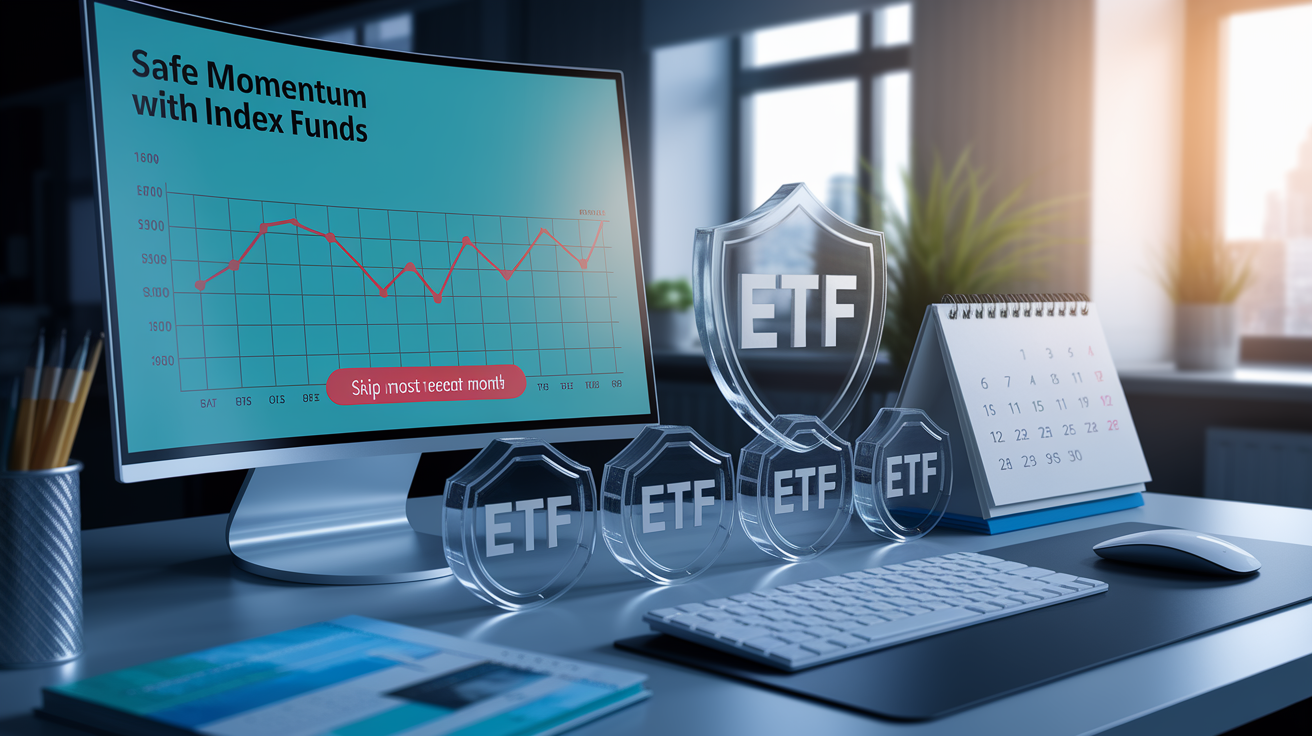
Momentum investing is a rules-based strategy that puts money into assets showing recent strong performance. You’re typically looking at returns over the past six to twelve months to rank what you’ll hold. Instead of trying to predict where things are headed, momentum just assumes that what’s been working lately will probably keep working in the short to medium term.
When you use index funds instead of individual stocks, momentum gets a lot safer. Broad index funds spread your risk across dozens or hundreds of securities, so you’re not betting the farm on any single company. You still get exposure to the upward price trends that make momentum work, but one bad earnings report or scandal won’t blow up your portfolio. Research shows momentum works across stocks, bonds, commodities, and different countries when you stick with it over long periods. A 12-month lookback (skipping the most recent month) has delivered consistent extra returns in academic studies going back to the 1920s, even after you account for transaction costs.
A safe momentum setup built on index funds needs these pieces:
Clear lookback window. Pick a consistent period, usually six to twelve months, to measure recent returns. Skip the most recent month to dodge short-term reversals.
Diversified universe. Choose from a broad pool of index ETFs covering stocks, bonds, international markets, and sectors. Not single stocks.
Fixed rebalancing schedule. Rebalance monthly or quarterly on a set date to stay disciplined and keep emotions out of it.
Position caps and limits. Never put more than 10 to 25% of your portfolio into a single momentum fund. Limit the total momentum piece to 10 to 30% of your assets if you’re conservative.
Rule-based exits. Use absolute momentum filters like selling if the 12-month return drops below zero or the price falls below the 200-day moving average. This cuts exposure during downturns.
Selecting Index Funds Suitable for Momentum Strategies

Not every index fund works for momentum. You want funds with clear selection rules, reasonable turnover, low costs, and enough liquidity so you can rebalance smoothly. Common momentum ETFs use quantitative systems that rank funds by recent price performance and rebalance on a predictable schedule. Popular options include MTUM (iShares MSCI USA Momentum Factor ETF), IMOM (Alpha Architect International Quantitative Momentum ETF), and MOM (Pacer TrendPilot 750 Momentum ETF). Each one uses different lookback periods, different universes, and different rebalancing rules. You need to know what you’re buying.
When you’re screening index funds for momentum, check the methodology section in the prospectus. Make sure it ranks holdings by past returns, not some subjective measure. Look for funds with expense ratios below 0.50%, high average daily trading volume (a few million dollars is good), and total assets above $100 million. That keeps bid-ask spreads tight and operations stable. Skip niche or thinly traded ETFs. They create execution drag and slippage that eat into any momentum benefit.
| ETF | Methodology | Rebalancing Frequency |
|---|---|---|
| MTUM | Selects stocks from MSCI USA Index with highest 6 and 12 month risk-adjusted price momentum | Quarterly |
| IMOM | Ranks international developed market stocks by 12 month return, selects top 50 excluding recent one month | Quarterly |
| MOM | Invests in S&P 500 when market is above 200 day SMA, moves to bonds and cash when below | Monthly |
Understanding Relative vs. Absolute Momentum Approaches
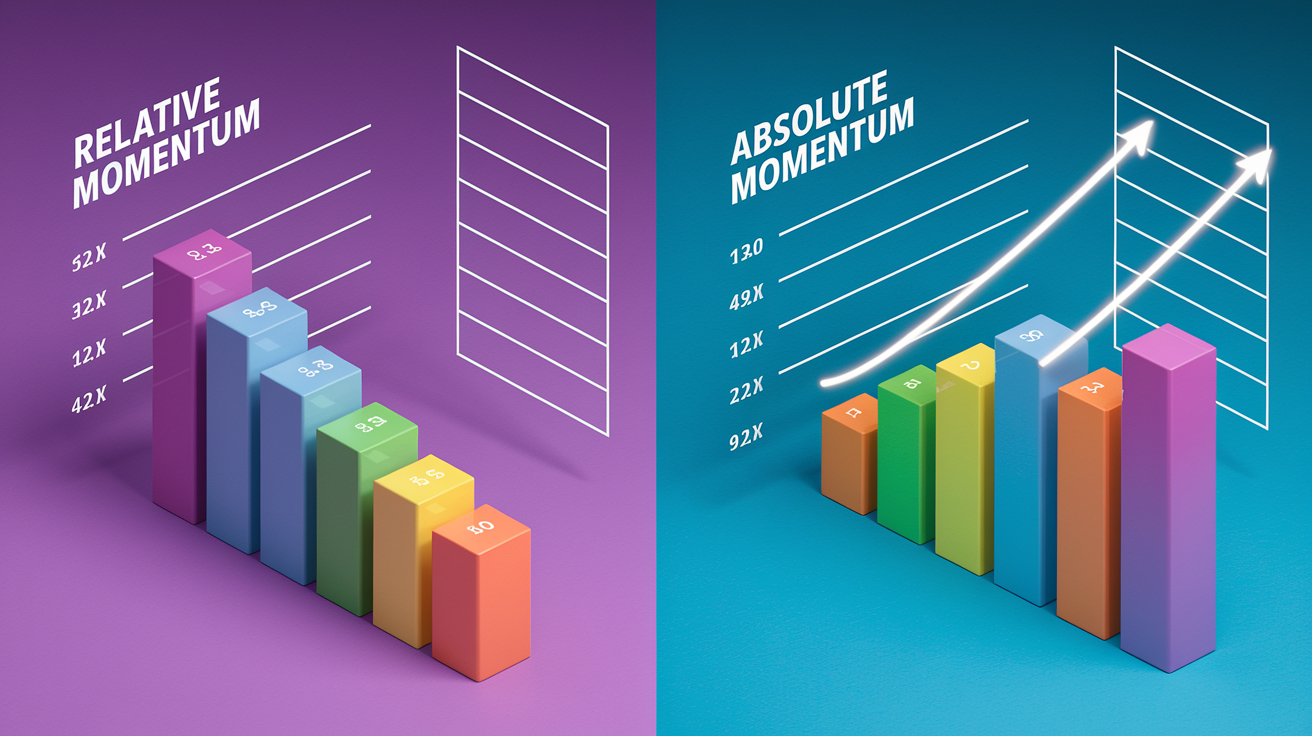
Relative momentum ranks a set of assets against each other and puts money into the top performers. Absolute momentum compares each asset to its own past or a fixed hurdle.
Relative momentum is simpler. You rank ten index funds by their 12-month return, pick the top three, and hold them until the next rebalance. This keeps you fully invested and captures the strongest trends in your universe. The catch? Relative momentum can pick the “least bad” option during a bear market. You might still lose money, just less than the other funds on your list. Researchers like Gary Antonacci promote a dual-momentum approach that combines relative and absolute rules. First you rank funds by relative performance, then you apply an absolute screen. Only hold a fund if its 12-month return is positive or above a benchmark like cash. If nothing passes the test, move the money to safety assets like short-term bonds or money market funds.
Absolute momentum gives you downside protection by shifting to cash or bonds when all risky assets are falling. The trade off? You might miss early rebounds if the switch happens late or the signal whipsaws. Combining both (relative for selection, absolute for a trend-following overlay) can cut drawdown severity while keeping upside participation. A blended rule might look like this: rank your universe, hold the top two funds that also have positive 12-month returns. If neither is positive, move to a cash-equivalent fund. This dual filter reduces whipsaw and concentration risk while keeping you out of deep declines.
Risk Management Techniques for Momentum Index Investing

Momentum can deliver higher returns, but it also creates larger drawdowns during reversals. Safe implementation means layering on controls that limit how far you can fall. Volatility filters are one tool. Before each rebalance, calculate the realized volatility of your momentum holdings over the past 30 or 60 days. If volatility spikes above a threshold (say, 20% annualized), cut position sizes or shift part of the money to bonds. Backtests show this simple overlay can reduce maximum drawdowns by several percentage points, though you give up slightly lower long-term returns.
Trend-following overlays add another layer. A common version uses a moving average crossover. Only hold momentum index funds when their price is above the 200-day simple moving average. When price drops below, switch that money to cash or short-term bonds. This rule helps you sidestep sustained bear markets, though it can produce false signals during choppy sideways markets. Spreading momentum across asset classes is just as important. Instead of applying momentum only to U.S. stocks, build a universe that includes international stocks, bonds, commodities, and REITs. Spreading momentum across things that don’t move together smooths returns and prevents a single crash from wrecking your entire strategy.
Here are four specific controls you can put in place:
Position caps. Limit any single momentum fund to 10% of total portfolio value and cap the entire momentum piece at 30% for moderate risk profiles, 50% for aggressive.
Trailing stops. Use a 15% trailing stop on individual momentum positions. Exit and move to cash if a holding falls 15% from its recent peak, then only re-enter when momentum criteria are met again.
Volatility parity. Scale position sizes inversely to recent volatility so each holding contributes roughly equal risk. This prevents overweighting the most volatile (and potentially fragile) funds.
Absolute momentum exit. Sell any fund whose 12-month total return falls below zero, regardless of relative rank. Move that capital to short-term bonds or a stable value fund until the fund’s momentum turns positive again.
Rebalancing Frequency and Implementation Details

Momentum signals decay after about 12 months, so you need to rebalance regularly to capture the benefit. Monthly rebalancing is the most responsive. Every 30 days you re-rank your universe and adjust holdings. This keeps you aligned with the freshest trends and can boost returns during fast-moving markets. The cost is higher turnover. Expect annual turnover of 100 to 200% with monthly rebalancing, which means more frequent capital gains realizations and higher trading commissions if you’re not careful about execution.
Quarterly rebalancing is a middle path. You still capture most of the momentum benefit while cutting turnover roughly in half. Many momentum ETFs like MTUM and IMOM rebalance quarterly. For individual investors managing their own momentum piece, quarterly is often the sweet spot. It’s frequent enough to stay current, infrequent enough to keep tax and transaction costs manageable. Annual rebalancing is too slow for momentum. By the time you adjust, winners have already reversed and losers have compounded.
Monthly rebalancing. Best for active momentum investors willing to monitor closely. Expect higher costs but maximum responsiveness to changing trends.
Quarterly rebalancing. Standard practice for most momentum index funds. Balances signal capture with cost control and works well for tax-conscious accounts.
Skip-month rule. When measuring momentum, exclude the most recent month (the “skip month”) to avoid short-term reversals. Rank on months 2 to 13, not 1 to 12. Academic research shows excluding the most recent month from the lookback improves risk-adjusted returns by cutting exposure to mean reversion.
Backtesting: What Historical Data Reveals About Index Fund Momentum

Academic studies stretching back to the 1920s document a persistent momentum benefit across stocks, bonds, currencies, and commodities. Momentum as a factor has historically delivered extra returns, often in the range of 1.0 to 3.0 percentage points annually, over broad market benchmarks before you account for costs and taxes. Index fund implementations of momentum show smoother performance than single stock momentum because diversification mutes the impact of any one security reversing sharply.
That smoothness comes with a catch. Momentum suffers occasional crashes, especially during sharp market reversals when recent winners suddenly underperform. Historical drawdowns in concentrated momentum portfolios have reached 30 to 60% during crisis periods. Index fund momentum reduces those extremes but doesn’t eliminate them. A diversified momentum piece using broad ETFs might see peak to trough declines of 20 to 35% during severe bear markets, compared to 15 to 25% for a plain market index.
| Period | Return Spread vs Market | Drawdown Severity |
|---|---|---|
| 1927–2020 (U.S. equities) | +2.5% annualized | –60% (2009 crisis, concentrated) |
| 2000–2020 (multi-asset index ETFs) | +1.8% annualized | –28% (2008–2009 diversified) |
| 2010–2020 (factor ETFs like MTUM) | +1.2% annualized | –18% (Q1 2020 COVID selloff) |
Realistic expectations matter. Momentum adds complexity, turnover, and tax drag. Net of costs and taxes, the actual benefit in a taxable account might shrink to 0.5 to 1.5% per year. In tax-advantaged accounts or with careful tax-loss harvesting, you can preserve more of the raw benefit. Backtesting your exact rules over at least a decade (including realistic transaction costs and slippage) gives you a clear picture of what to expect and helps you size positions conservatively.
Constructing a Momentum Driven Portfolio Using Index Funds

Building a momentum portfolio starts with defining your universe. A diversified multi-asset universe might include ten index ETFs: U.S. large cap, U.S. small cap, developed international, emerging markets, U.S. aggregate bonds, TIPS, commodities, REITs, high-yield bonds, and cash. Each month or quarter you rank these ten funds by their 12-month return (excluding the most recent month) and put money into the top three. This spreads risk across asset classes and prevents over-concentration in a single country or sector.
Position sizing comes next. A conservative approach might dedicate 20% of your total portfolio to momentum and keep the other 80% in a static 60/40 stock/bond mix. Within that 20% momentum piece, split capital equally among your top three ranked funds (roughly 6.7% of total portfolio value each). A moderate investor might push the momentum piece to 30%, and an aggressive investor to 50%, but don’t exceed those caps without understanding the downside risk. Capping any single fund at 10 to 15% of total portfolio value keeps you diversified even when momentum concentrates in one hot asset class.
Rebalancing rules and overlays complete the setup. Use absolute momentum filters to move capital out of risky assets during broad downturns. If none of your top-ranked funds show a positive 12-month return, shift the momentum money to short-term bonds or a money market fund. This dual momentum approach (relative ranking plus absolute trend filter) reduces the chance of riding a momentum position all the way down during a bear market. After a market recovery, the absolute filter will signal re-entry once 12-month returns turn positive again, letting you capture the rebound without trying to time the bottom.
Here’s a four-step process for momentum portfolio construction:
Define your universe. Select 8 to 12 index funds spanning U.S. stocks, international stocks, bonds, and alternatives. Make sure each fund has low expenses, high liquidity, and transparent methodology.
Set allocation caps. Decide on a total momentum piece size (10 to 30% for conservative to moderate risk tolerance) and a per-fund cap (10 to 15% of total portfolio).
Apply ranking and selection rules. Each rebalance period, rank all funds by 12-month return (skip most recent month), select the top 2 to 4 funds, and split the money equally within the momentum piece.
Layer absolute momentum filter. Only hold a fund if its 12-month return is positive. If all top-ranked funds are negative, move the entire momentum allocation to cash or short-term bonds until momentum turns positive.
Tax and Cost Considerations for Momentum Index Strategies
Momentum strategies create higher turnover than buy and hold indexing, which means more frequent capital gains realizations. In a taxable account, those gains are taxed annually, and frequent rebalancing can push short-term gains (taxed at ordinary income rates) higher than long-term gains. Depending on your marginal tax rate and rebalancing frequency, tax drag can range from 0.3% to over 1.5% per year. Using ETFs instead of mutual funds helps. ETFs rarely distribute capital gains because of their in-kind redemption mechanism. But turnover inside the fund or your own rebalancing still creates taxable events.
The most effective way to cut tax drag is to hold your momentum piece in a tax-advantaged account like an IRA or 401(k). Inside those accounts, you can rebalance as often as you need without triggering immediate taxes. If you must run momentum in a taxable account, favor quarterly over monthly rebalancing, use tax-loss harvesting throughout the year to offset gains, and consider putting the “safe” side of an absolute momentum strategy (cash or short-term bonds) in municipal bond funds for tax-free income. ETF expense ratios also matter. A momentum ETF charging 0.50% versus one charging 0.15% will cost you an extra 0.35% per year. Compounded over decades, that difference is significant.
Favor tax-advantaged accounts. Hold high turnover momentum index funds in IRAs or 401(k)s to avoid annual capital gains taxes. Keep static core holdings in taxable accounts.
Choose low expense ETFs. Target momentum index funds with expense ratios below 0.30%. Every 0.10% saved improves net long-term returns without additional risk.
Harvest losses and manage timing. In taxable accounts, sell losing momentum positions before year-end to realize losses that offset gains. Re-enter similar (but not identical) funds after 30 days to avoid wash-sale rules. Systematic tax-loss harvesting can recover 0.5 to 1.0% of annual after-tax return in volatile momentum pieces.
Final Words
In the action, we defined momentum as a rules-based, past-return method and showed how index funds add safety by diversifying away single-stock risk.
You learned how to pick momentum-friendly ETFs, compare relative and absolute approaches, use volatility filters and rebalancing, and mind taxes and costs.
Follow clear rules and regular rebalancing so you can apply momentum) with index funds safely, reduce panic-driven moves, and keep your plan on track. That steady approach improves your chances of long-term progress.
FAQ
Q: What is Warren Buffett’s favorite index fund?
A: Warren Buffett’s favorite index fund is a low-cost S&P 500 index fund; he often recommends Vanguard’s S&P 500 fund as a default choice for most investors.
Q: Are momentum index funds good for long-term?
A: Momentum index funds can work long-term but carry higher turnover and episodic drawdowns; use diversification, trend filters, and disciplined rebalancing to manage risk.
Q: What if I invested $10,000 in S&P 500 20 years ago?
A: Investing $10,000 in the S&P 500 20 years ago would likely have grown several-fold; a typical range is roughly $30,000–$60,000 before taxes, depending on exact dates and dividends.
Q: What is the 7 3 2 rule?
A: The 7 3 2 rule is a simple momentum filter using 7-, 3-, and 2-month return checks; an asset passes if recent returns are positive across those windows, reducing false signals.