


Which is smarter: trusting a single fund that does everything for you, or building your own mix to cut fees and control taxes?
Target-date funds pick a glide path and rebalance for you as you near retirement.
DIY means choosing a U.S. stock fund, an international fund, and a bond fund, then rebalancing on a schedule.
Which fits you comes down to four things: how much time you want to spend, the fees you’ll pay, where you hold each asset for taxes, and whether you’ll stick to the plan during a market drop.
Target-Date Funds vs. DIY Portfolios: Quick Comparison Summary

Target-date funds bundle everything into one ticker. You pick a year that’s close to when you’ll retire (2050, for example) and the fund does the rest. It starts stock-heavy, then gradually adds bonds as you get closer to leaving work. DIY strategies let you build the same thing yourself: grab a U.S. stock index, an international stock index, and a bond fund. You decide the percentages and handle rebalancing when things drift.
Performance? It comes down to your asset mix and what you’re paying in fees. Not whether you own one fund or three.
The actual differences are about cost, control, how much time you want to spend, and where you put things for tax reasons. Target-date funds automate the shift and remove the “what should I do now?” paralysis. DIY gives you room to adjust allocations, cut expenses, and place assets where they’ll save you the most on taxes. But only if you’ll actually rebalance and keep your cool when the market tanks.
Quick breakdown:
- Cost: Index target-date funds run 0.06% to 0.15%. Actively managed ones? 0.40% to 0.75%. DIY index portfolios can stay under 0.10%.
- Rebalancing: Target-date funds do it for you. DIY means you’re doing it yourself every few months or once a year.
- Customization: Target-date funds follow a set path. DIY lets you tweak bond percentages, tilt international, or keep more stocks longer if you want.
- Tax placement: Target-date funds live in one account. DIY lets you stick bonds in tax-deferred spots and equities in taxable accounts.
- Behavioral safety: Target-date funds cut down on emotional trades. DIY requires you to stay disciplined and not panic-sell.
- Time: Target-date funds need almost no attention. DIY takes an hour or two per quarter if you’re managing multiple accounts.
Both give you similar returns when fees are low and you’re following a reasonable stock/bond split. Which one’s right depends on whether you want convenience or control, and whether you’ll stick to your own rebalancing schedule.
Cost Differences and Fee Impact Over Time

Target-date funds often stack two fees. There’s the expense ratio of the target-date wrapper, plus the weighted cost of whatever funds are inside it. Some providers just charge the blended expense of the underlying funds. Index versions from Vanguard or Fidelity usually sit around 0.08% to 0.12%. Actively managed target-date series from insurance companies or smaller providers can hit 0.50% to 0.75%, because you’re paying managers to pick stocks and bonds inside the wrapper.
DIY portfolios skip the wrapper entirely. You own each piece directly. U.S. total market at 0.04%, international stock at 0.11%, total bond at 0.05%. If you split it 54% U.S. stock, 36% international, 10% bonds (roughly what a 2050 target fund looks like), your weighted expense is around 0.07%. That’s a 0.01% to 0.05% savings versus a cheap target-date fund, or a 0.43% to 0.68% advantage over an expensive actively managed one.
A 0.20% fee gap on $500,000 invested for 25 years, earning 7% before fees, costs you about $85,000 in final value. A 0.50% gap? Around $200,000. Here’s how the ranges typically break down:
| Option | Typical Expense Ratio | Notes |
|---|---|---|
| Low‑cost index TDF | 0.06%–0.15% | Vanguard, Fidelity, Schwab index series |
| Actively managed TDF | 0.40%–0.75% | Adds active sub‑funds; check if performance justifies cost |
| DIY index portfolio | 0.04%–0.10% | Weighted average of component funds; no wrapper fee |
| DIY active portfolio | 0.30%–1.00%+ | Pick actively managed funds and fees climb fast |
Even tiny expense differences compound hard. If your target-date fund charges 0.15% and your DIY blend is 0.07%, you’re saving 0.08% every year. On a $1,000,000 portfolio that’s $800 annually, and it compounds for decades. Always check the total cost, not just what the ticker shows.
Performance Variability and Glide Path Differences

Two 2050 target-date funds can hold completely different stock/bond splits at the same moment. One provider might run 90% stocks when you’re 40. Another might do 80% stocks and 20% bonds. Getting closer to retirement, one fund shifts to 50% stocks at 65, while another keeps 65% stocks. These gaps show up hardest during crashes. A bond-heavier fund drops less but also climbs slower when things recover.
DIY investors pick their own glide path or just stick with a fixed split. If you’ve got pension income or Social Security covering most of your expenses, you might keep 70% stocks into your 60s. Risk-averse or retiring early? You might drop to 40% stocks at 55. The flexibility matters when your life doesn’t match the average retirement-age worker the target-date fund assumes.
Performance gaps between target-date funds and DIY portfolios usually trace back to three things: the stock/bond split, how much you hold in U.S. versus international, and fees. A 90/10 portfolio beats a 70/30 in a bull market and loses more in a bear market. Doesn’t matter if you own one fund or three. The wrapper doesn’t create returns. The asset mix does. If you match the allocation, costs, and rebalancing, a target-date fund and a DIY portfolio give you nearly the same result before taxes and behavior. The real variable is whether you’ll actually stick to your plan when markets fall 30%.
Customization and Flexibility
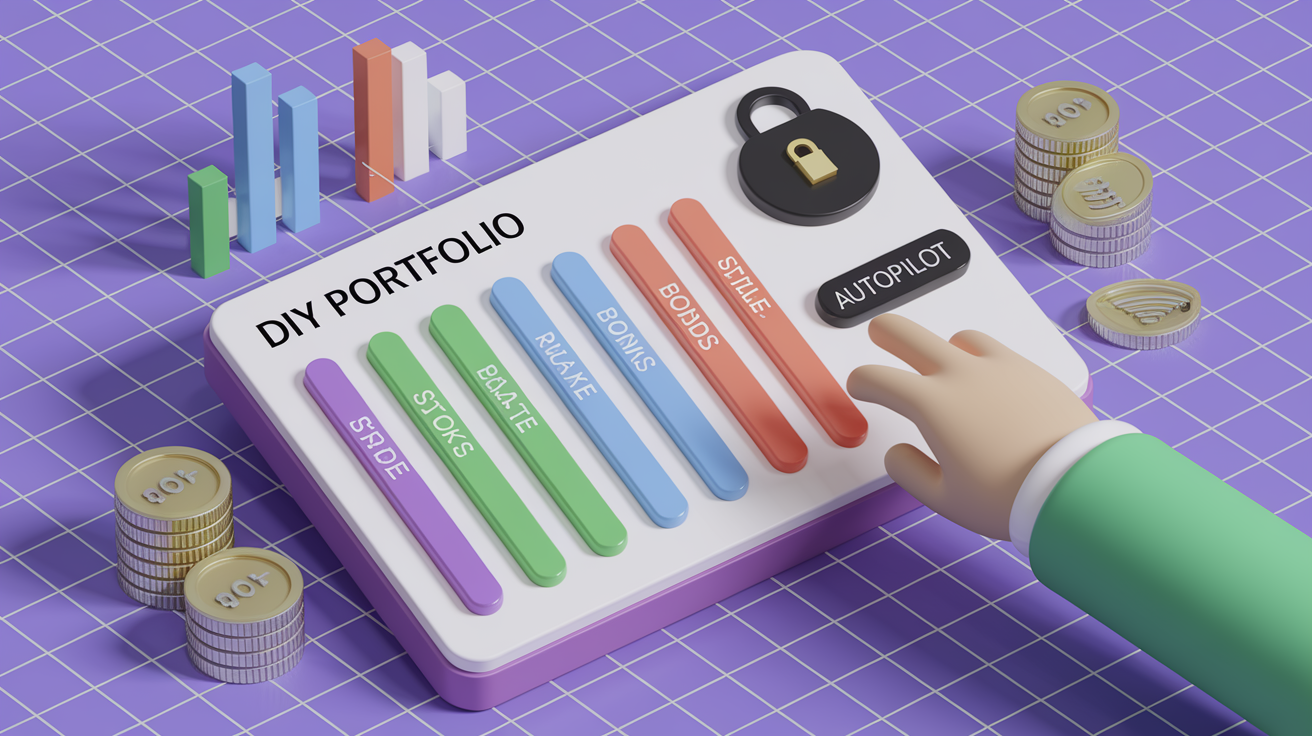
Target-date funds make one big assumption. You’ll retire around the year in the fund’s name and you don’t have other guaranteed income. If you’re working until 70, retiring at 55, or getting a pension that covers half your bills, the standard path might be too conservative or too aggressive. You can’t tweak the bond percentage inside a target-date fund without switching to a different year, and that creates a mismatch between the fund’s timeline and when you’re actually leaving work.
DIY portfolios let you build your own path and change it as you go. You can tilt toward small-cap value, add real estate, bump up international, or stay 100% stocks if volatility doesn’t bother you. You control when and how much you shift into bonds, and you can pause the whole thing if market conditions or your money situation changes.
Where DIY gives you more control:
- Asset allocation: Set your own stock/bond split independent of a target year.
- Geographic tilt: Overweight international, emerging markets, or stay U.S. only.
- Factor exposure: Add small-cap, value, or sector funds if that’s your thing.
- Glide-path timing: Shift to bonds faster or slower based on markets or your personal comfort with risk.
- Account coordination: Put bonds in tax-deferred, equities in taxable, and spread things across IRAs, 401(k)s, and brokerage accounts.
Customization only helps if you’ve got a clear reason to go off the standard path and you know how to do it. If you’re guessing or changing things because of headlines, you’re better off with the autopilot. Flexibility becomes useful when your financial life doesn’t fit the template.
Time Commitment, Rebalancing, and Ongoing Management

Target-date funds rebalance themselves, usually every quarter. They adjust the stock/bond mix along the glide path without you doing anything. You put money in, the fund handles allocation, and you check your account once a year to make sure contributions are flowing. Total time: under 30 minutes annually. Hold it in a 401(k) and never look at it except during open enrollment? Still works.
DIY portfolios need you to watch for drift and rebalance manually. If your target is 70% stocks and 30% bonds, a strong equity year might push you to 75/25. You sell some stock, buy bonds, restore the target. Most people rebalance once or twice a year. Some use new money to buy whatever’s low instead of selling. Either way, you’re making decisions and logging into multiple accounts if your portfolio spans a 401(k), IRA, and taxable brokerage.
Time commitment goes up when you’re coordinating multiple accounts. A DIY setup across three accounts (traditional IRA, Roth IRA, taxable brokerage) means checking allocations in each, making sure the combined total hits your target, and maybe moving money or rebalancing unevenly to keep bonds tax-deferred and stocks taxable. That adds complexity and about an hour or two per quarter if you’re being thorough.
Typical DIY tasks:
- Check overall allocation. Quarterly or after big market moves to see if drift crosses your threshold (usually ±5%).
- Rebalance across accounts. Annually or twice a year. Sell high, buy low, or point new contributions at whatever’s underweighted.
- Review fund expenses and performance. Once a year. Confirm your index funds still track their benchmarks and fees haven’t crept up.
- Adjust glide path. Every five years or when life changes (new job, inheritance, early retirement). Shift bond allocation if needed.
If you like the process or want the control, the time cost is small. If rebalancing feels like a chore you’ll skip, a target-date fund removes the risk that you’ll drift into the wrong allocation or freeze during a crash.
Tax Efficiency and Account Placement
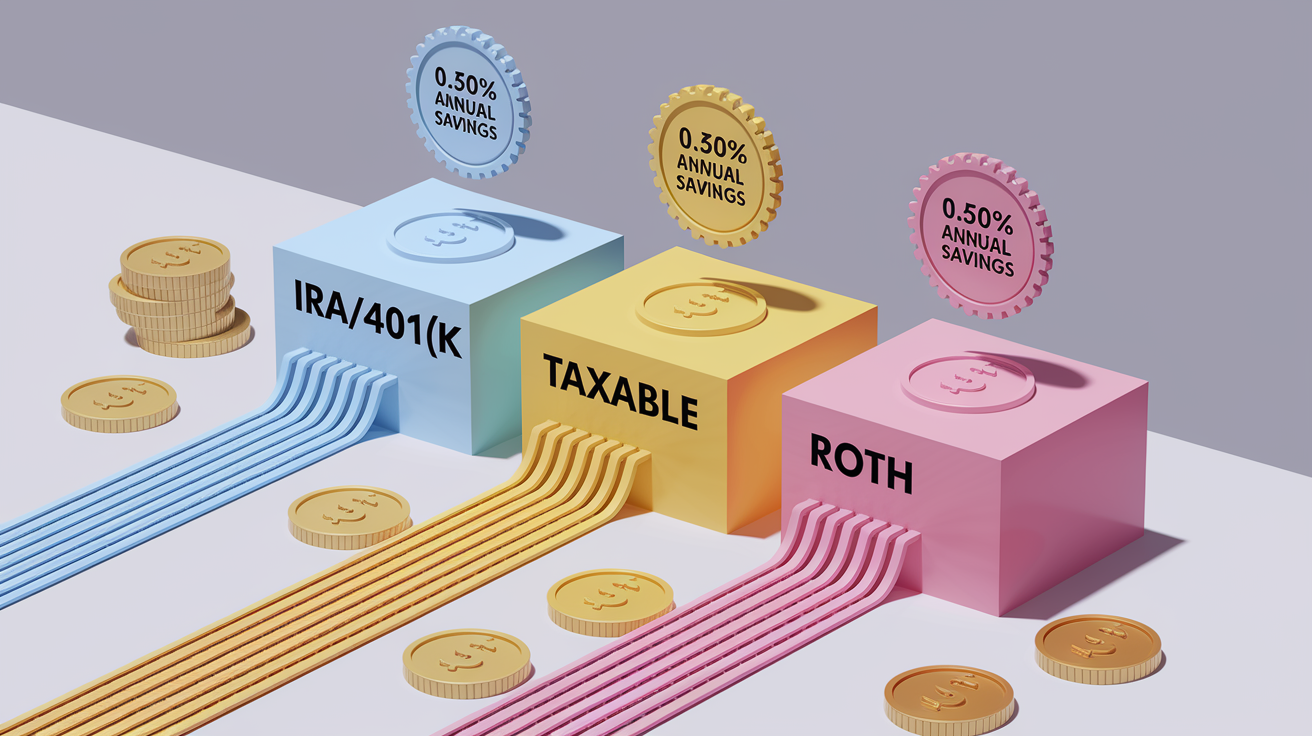
Target-date funds work great inside 401(k)s and IRAs because all the rebalancing and dividend payouts happen in a tax-deferred wrapper. You don’t pay capital gains when the fund sells stocks to buy bonds, and you don’t owe taxes on bond interest until you pull money out in retirement. But hold a target-date fund in a taxable brokerage account? Every internal rebalancing trade can trigger capital gains you can’t control, and the bond piece throws off ordinary income taxed at your rate every year.
DIY lets you split assets across account types to cut taxes. Common move: put your bond index fund entirely in your traditional IRA or 401(k), where interest gets deferred, and keep U.S. and international stock funds in your taxable account, where qualified dividends and long-term gains get better rates. When you rebalance, you sell bonds in the IRA (no tax event) and leave equities in taxable to keep compounding. Need to sell equities? You can pick which tax lots to sell and harvest losses to offset gains.
This tax-location setup can save 0.30% to 0.50% annually on a big taxable portfolio. Easily more than the fee difference between a target-date fund and DIY. But it only works if you have multiple account types and enough in each to make splitting worth it. If everything’s in a 401(k), tax placement is irrelevant and a target-date fund is just as efficient as DIY. Got $200,000 in taxable and $500,000 in IRAs? Putting bonds in the IRA and equities in taxable can meaningfully cut your yearly tax bill and leave more to grow.
Which Investors Are Best Suited for Each Approach

Target-date funds work for people who want investing to fade into the background. Early in your career, contributing steadily, prone to second-guessing yourself when markets swing? A target-date fund removes the temptation to mess with things. The automatic glide path and rebalancing mean you can ignore financial news, skip the yearly “should I move to bonds?” question, and dodge the behavioral mistakes that cost the average investor 3% to 4% per year.
DIY suits investors who want control, have time to manage allocations, and either enjoy the process or want to squeeze out tax and cost savings. Coordinating a 401(k), traditional IRA, Roth IRA, and taxable brokerage? DIY lets you place assets strategically and rebalance in the most tax-smart way. Got a pension or rental income that acts like bond exposure? You can keep your portfolio more aggressive than a target-date fund would. Disciplined enough to rebalance during crashes instead of selling? You’ll capture the modest cost and tax edge without giving it back through emotional trading.
Target-date funds fit best if you:
- Want a single fund handling diversification, rebalancing, and risk reduction on its own.
- Tend to overthink allocation or worry you’ll panic-sell when markets drop.
- Invest mostly in a 401(k) or IRA with no taxable accounts needing separate strategies.
- Prefer spending zero time on portfolio maintenance and you’re fine with a standard glide path.
DIY portfolios fit best if you:
- Want to cut costs and you’re willing to rebalance manually once or twice a year.
- Have multiple account types and can benefit from tax-smart asset placement.
- Need a custom glide path because of early retirement, late retirement, pension income, or higher comfort with risk.
- Enjoy managing your investments and trust yourself to stick to a plan during volatility.
Final Words
You’ve seen the trade-offs: target-date funds give automatic glide paths and less work, while DIY multi-fund strategies give more control, lower predictable fees, and need rebalancing and placement decisions. Costs, glide paths, and time are the big levers.
If you’re comparing all-in-one target date funds versus DIY multi-fund strategies, pick the one that matches how much time and control you want. Both can work long term if you stick to a simple plan and keep costs low. You’ve got this.
FAQ
Q: What does Warren Buffett think of target-date funds, and what is Warren Buffett’s favorite index fund?
A: Warren Buffett views target-date funds as a sensible, hands-off choice for many investors; his favorite index fund is the Vanguard S&P 500 index fund, praised for low costs and broad exposure.
Q: Should I do a single fund strategy or build my own portfolio?
A: Choosing a single fund or building your own depends on whether you want simplicity or control; a single fund is a solid default, while DIY lowers fees and customizes risk but needs more time.
Q: What does Suze Orman say about target-date funds?
A: Suze Orman says target-date funds offer convenience but you should check the glide path, fees, and whether the fund’s asset mix fits your retirement age, since one size doesn’t fit all.