
Want to know a secret most financial pros won’t tell you?
You don’t need to chase hot stocks or pay big fees to build a strong retirement nest egg.
In under an hour you can set up a simple, low-cost index fund portfolio that owns thousands of companies and bonds, spreads risk across the world, and keeps yearly fees under $10 per $10,000 invested.
This post gives clear, step-by-step instructions for beginners so you can start with confidence and keep it cheap.
Getting Started with a Simple, Low-Cost Index Fund Portfolio

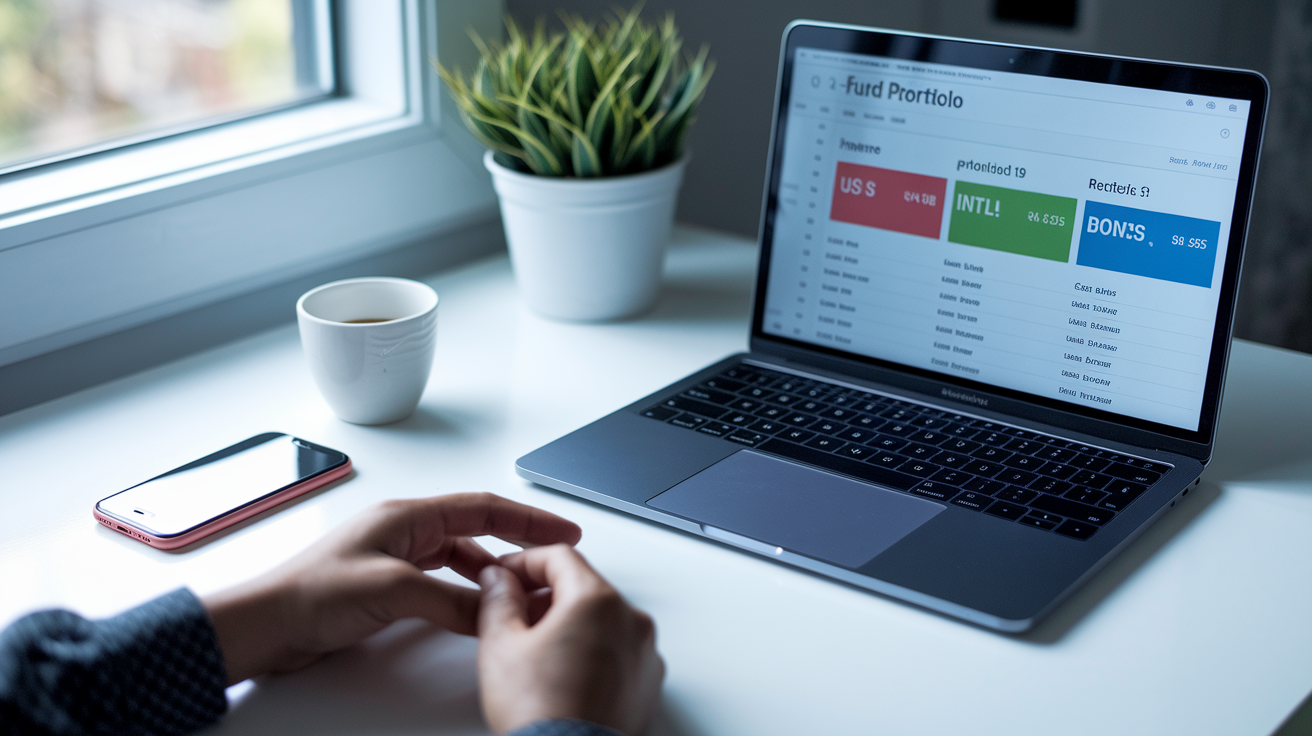
A solid beginner portfolio needs three things: a U.S. total stock market fund, an international total stock market fund, and a total bond market fund. That’s it. You can build this in under an hour using low-cost index funds from Vanguard, Schwab, or Fidelity. This setup gives you ownership in thousands of companies and bonds, spreads your risk across the global economy, and keeps your yearly fees under $10 per $10,000 invested.
Index funds track a market index instead of trying to beat it. When you buy a U.S. total stock market index fund, you’re buying a slice of thousands of publicly traded companies weighted by their market size. Index funds rarely trade their holdings, which keeps transaction costs and taxable distributions low. They follow the index automatically. The fund manager’s job is simple: match the index, keep fees minimal.
Cost matters because every dollar you pay in fees is a dollar that never compounds. As of June 2024, many core index funds charge between 0.03% and 0.07% per year. That’s $3 to $7 in annual fees per $10,000 invested. You want funds with expense ratios below 0.10%. Here’s what the three-fund model looks like:
- U.S. total stock market – VTI (Vanguard Total Stock Market ETF, expense ratio 0.03%), SCHB (Schwab U.S. Broad Market ETF, 0.03%), or ITOT (iShares Core S&P Total U.S. Stock Market ETF, 0.03%).
- International total stock market – VXUS (Vanguard Total International Stock ETF, 0.07%), SCHF (Schwab International Equity ETF, 0.06%), or IXUS (iShares Core MSCI Total International Stock ETF, 0.07%).
- Total bond market – BND (Vanguard Total Bond Market ETF, 0.03%), SCHZ (Schwab U.S. Aggregate Bond ETF, 0.04%), or AGG (iShares Core U.S. Aggregate Bond ETF, 0.04%).
If you want deeper context on how to mix these funds and adjust to your timeline and risk comfort level, the Three-Fund Portfolio Guide on Bogleheads walks through the full framework, including historical performance data and rebalancing strategies.
The three-fund approach works because it’s simple, cheap, and complete. You own equities in developed and emerging markets plus a stabilizing bond allocation. No need to pick individual stocks or chase sectors.
How Index Funds Operate Behind the Scenes
Index funds use a rules-based system. A committee defines which securities belong in the index and how much weight each one gets, usually by total market capitalization. When a company grows, its weight in the index rises. When a company shrinks or is acquired, the index adjusts. Your fund mirrors those changes automatically by buying or selling small amounts periodically, often once per quarter or when significant index adjustments occur.
Low turnover is one reason index funds stay tax-efficient. Most funds turn over only 3% to 6% of their holdings each year. Compare that to the 80% or higher turnover you see in many active funds. Fewer trades mean fewer taxable capital gains distributions for you. ETFs carry an additional tax advantage: their “in-kind” creation and redemption process lets managers offload appreciated shares without triggering a taxable event for remaining shareholders.
| Type | Minimums | Trading Style |
|---|---|---|
| ETF | Price of one share (many brokers now offer fractional shares) | Trades like a stock during market hours; use limit orders to control price |
| Mutual Fund | Varies: $0 (Fidelity ZERO funds) up to $3,000 (Vanguard Admiral shares) | One trade per day at end-of-day NAV; easier to set up automatic contributions |
Choosing Low-Cost Index Funds for a Beginner Portfolio
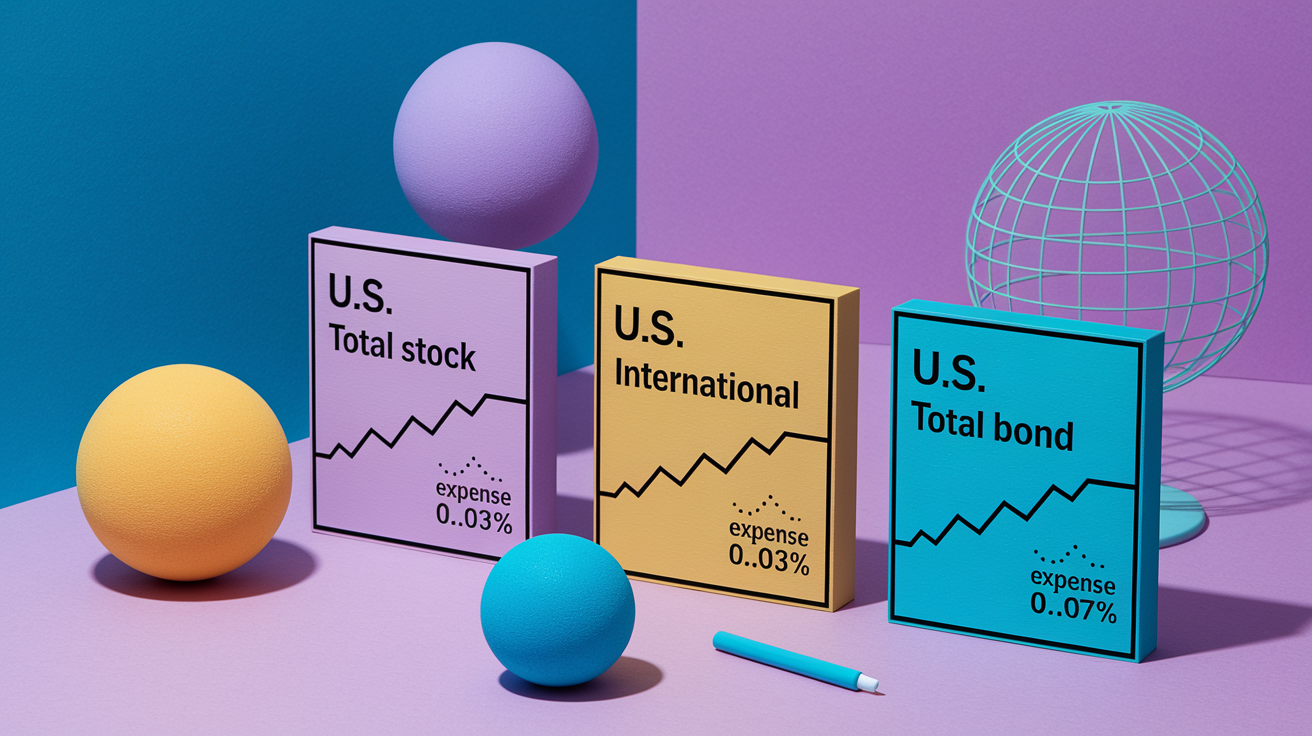
The best index funds combine three traits: very low expense ratios, large assets under management, and broad market coverage. Large fund size keeps bid-ask spreads tight for ETFs and operation stable. Broad coverage means the fund owns hundreds or thousands of securities, so one company’s failure barely registers.
Vanguard, Schwab, Fidelity, and iShares (BlackRock) all offer excellent beginner options. Vanguard pioneered low-cost indexing and runs its funds at cost for fund shareholders. Schwab and Fidelity compete aggressively on price and have lowered fees across their index lineups. iShares offers comparable ETFs with strong liquidity. All four allow commission-free trading of their own ETFs and often competitors’ ETFs as well.
When picking funds, look at the expense ratio first. Then verify the fund tracks the index you want. A 0.03% fund and a 0.07% fund are both excellent if they give you the same exposure. Here are top beginner-friendly picks by asset class:
- Vanguard: VTI (U.S. total stock, 0.03%), VXUS (international stock, 0.07%), BND (U.S. total bond, 0.03%).
- Schwab: SCHB (U.S. broad market, 0.03%), SCHF (international equity, 0.06%), SCHZ (U.S. aggregate bond, 0.04%).
- iShares: ITOT (U.S. total stock, 0.03%), IXUS (international stock, 0.07%), AGG (U.S. aggregate bond, 0.04%).
- Fidelity mutual funds: FZROX (U.S. total market, 0.00%), FTIHX (international stock, 0.06%), FXNAX (U.S. bond index, 0.025%).
- Vanguard mutual funds (Admiral shares): VTSAX (U.S. total stock, 0.04%), VTIAX (international stock, 0.11%), VBTLX (U.S. total bond, 0.05%).
All five options give you complete coverage of their respective markets and keep your total annual cost under $10 per $10,000 invested across a balanced three-fund portfolio.
Building Your Beginner Asset Allocation with Low-Cost Index Funds
Asset allocation means deciding how much to put in stocks versus bonds. Stocks offer higher long-term returns but swing more year to year. Bonds provide stability and income but grow more slowly. Your mix depends on when you’ll need the money and how comfortable you are watching the balance drop 20% or more in a bad year.
A common starting point for younger investors is an 80/20 split: 80% stocks and 20% bonds. Within the stock sleeve, many people use 60% U.S. and 20% international, though you can adjust based on preference. If you’re saving for a goal 30 years away and can handle volatility, you might go 100% stocks. If you’re five years from retirement, a 40/60 or 30/70 stock to bond mix reduces the chance a bear market wipes out years of gains right when you need the money.
Here are four sample allocations. Pick the one closest to your risk comfort and time horizon, then adjust as your situation changes:
| Portfolio Type | U.S. Stock % | International % | Bond % |
|---|---|---|---|
| Aggressive Growth (all equity) | 75 | 25 | 0 |
| Growth (high equity) | 60 | 20 | 20 |
| Balanced | 40 | 20 | 40 |
| Conservative | 30 | 10 | 60 |
You can also simplify the equity split by using global market-cap weights, which would be roughly 60% U.S. and 40% international within your total stock allocation. Some investors prefer home-country bias and tilt heavier to U.S. stocks. Either approach works as long as you maintain meaningful international exposure and stick with the plan through market cycles.
Step-by-Step Guide to Implementing Your Low-Cost Index Portfolio
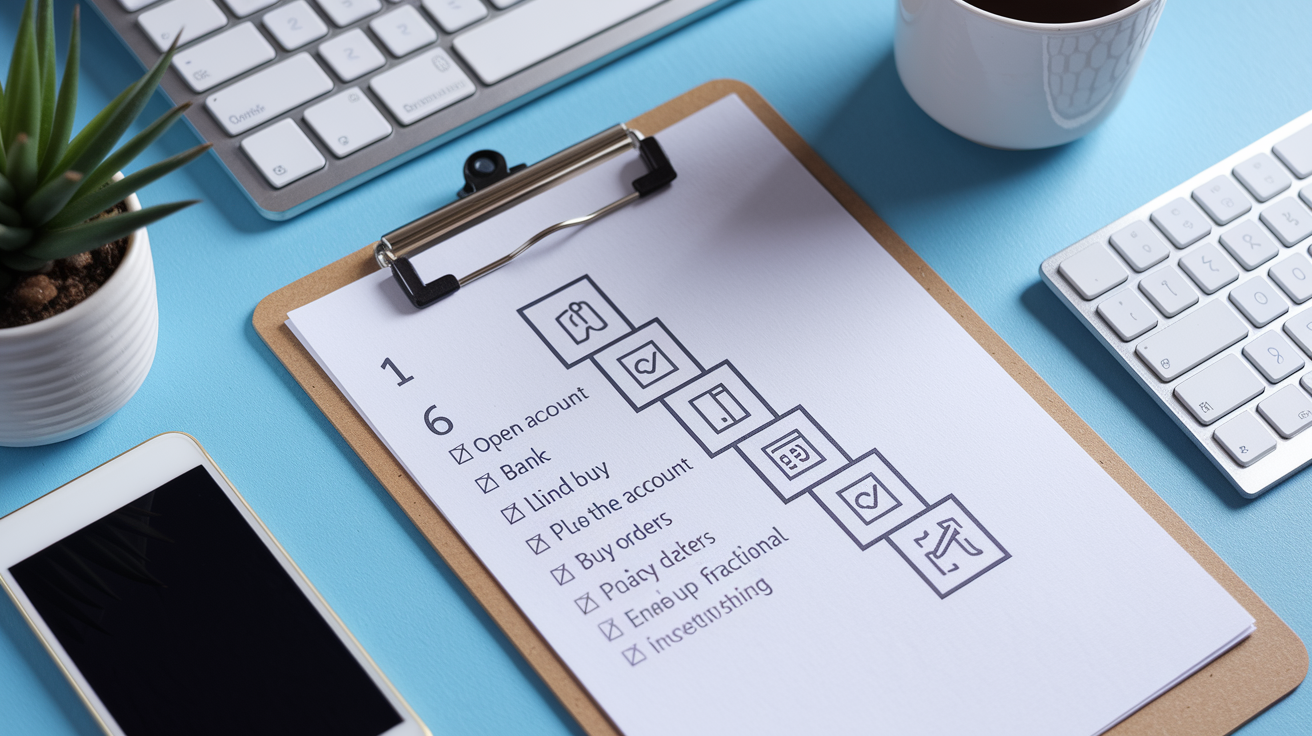
Opening a brokerage account takes about 10 minutes. You’ll need a Social Security number, a government-issued ID, your bank account routing and account numbers, and basic employment information. Vanguard, Schwab, and Fidelity all offer online applications. Choose an account type first: a taxable brokerage account for flexibility, a Roth IRA if you want tax-free growth, or a Traditional IRA for an upfront tax deduction.
Most brokers now support fractional shares for many ETFs and all mutual funds, so you can start with $100 or less and still hit your target allocation percentages. If fractional shares aren’t available for your chosen ETF, consider the mutual fund version or simply round to whole shares and adjust with future contributions. Here’s the complete setup:
-
Open your account online. Select the account type that fits your tax situation and funding source. If rolling over an old 401(k), choose a rollover IRA.
-
Link your bank account. Provide routing and account numbers. Initial transfers often take 2 to 4 business days.
-
Fund the account. Transfer your starting amount. Set up automatic monthly contributions if you plan to dollar-cost average.
-
Place buy orders. For ETFs, use a limit order set at or slightly above the current price to avoid overpaying. For mutual funds, enter the dollar amount and the trade executes at end-of-day net asset value.
-
Enable fractional shares if available. This lets you invest every dollar instead of leaving cash uninvested while you wait to afford a full share.
-
Set up automatic investing. Schedule monthly purchases to match your target allocation, or manually rebalance once or twice per year.
For more ideas on expanding or customizing your setup, DIY Portfolio Basics walks through alternative structures, including four-fund and five-fund portfolios that add real estate or additional bond diversification.
Rebalancing and Maintaining a Low-Cost Index Fund Portfolio

Rebalancing means bringing your portfolio back to its target percentages after market movements push things out of line. If you start with 60% stocks and 40% bonds and a strong stock rally pushes you to 66% stocks, you either sell stocks and buy bonds or direct new contributions to bonds until you’re back at 60/40. This process forces you to sell high and buy low. Feels uncomfortable, but it improves long-term returns.
Calendar-based rebalancing works well for most beginners: check your allocation once per year and adjust if any asset class has drifted more than 3 to 5 percentage points from target. Threshold-based rebalancing triggers an adjustment as soon as drift crosses your chosen limit, which can be more responsive in volatile markets but requires more frequent monitoring. Either method works. Pick one and stick with it.
- Use new contributions first. Instead of selling, put fresh money into the asset class that’s below target until balance is restored.
- Rebalance inside tax-advantaged accounts when possible. Selling in an IRA or 401(k) doesn’t create a taxable event.
- In taxable accounts, check for tax-loss harvesting opportunities. If you need to sell a position that’s down, the loss can offset other gains.
- Ignore small drifts. A 1% or 2% deviation isn’t worth the transaction cost or tax friction. Wait until drift is meaningful.
- Keep records. Note your target allocation and the date of each rebalance so you can see patterns and stay disciplined.
A three-fund portfolio rebalances quickly because you’re only adjusting three positions. The process takes less than 15 minutes per year once you’ve practiced it.
Managing Taxes and Minimizing Costs in Index Portfolios
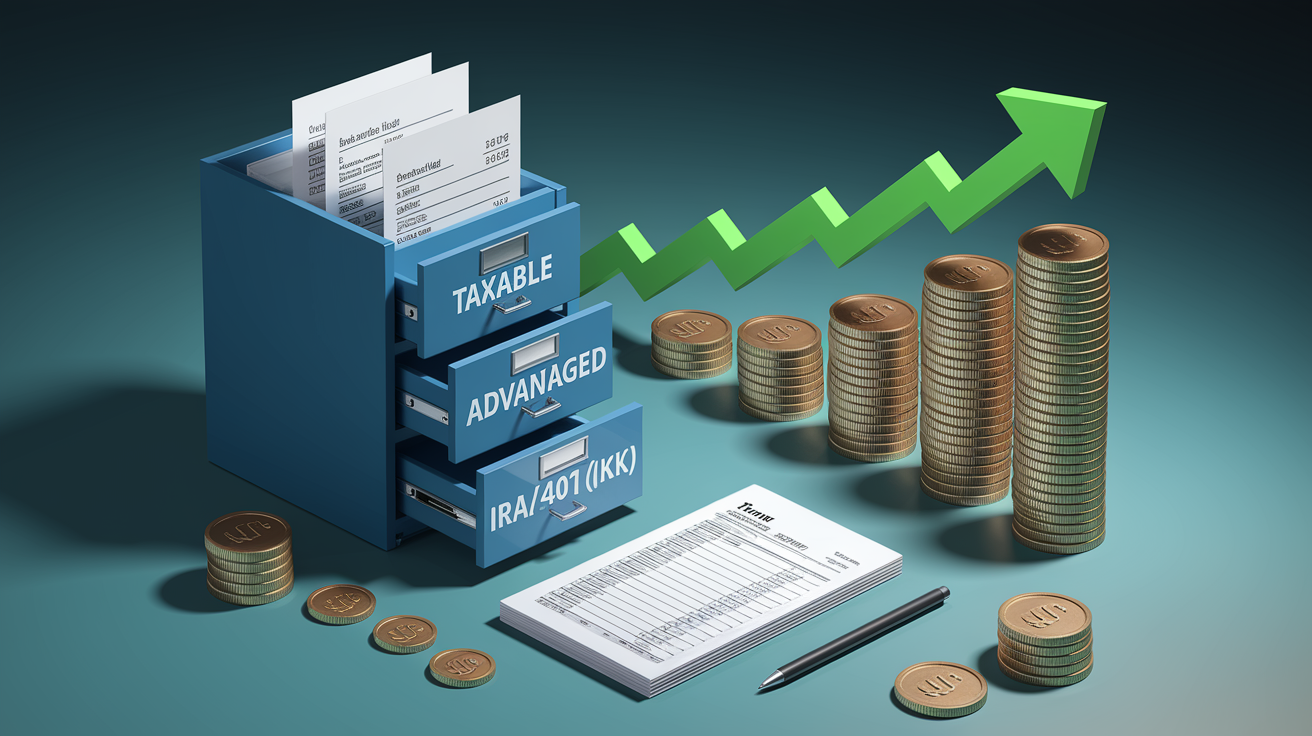
Where you hold your funds matters as much as which funds you choose. Bonds and other income-generating assets belong in tax-advantaged accounts like IRAs or 401(k)s because interest income is taxed at ordinary income rates. Broad stock market index funds are tax-efficient and can live in taxable accounts without creating large annual tax bills, especially if you avoid selling and let the position compound.
Real estate funds (REITs) throw off dividends that don’t qualify for preferential tax treatment, so they also belong in retirement accounts. If you’re adding a REIT fund to a five-fund portfolio, prioritize placing it in your IRA. Keep your total stock market and international stock funds in taxable accounts if space is limited in your IRA. Bonds go into the IRA next, followed by REITs, then international stocks, then U.S. stocks.
Expense ratios compound silently. A fund charging 0.50% per year costs you roughly 0.45% more annually than a fund charging 0.05%. Over 30 years, that difference becomes tens of thousands of dollars on a mid-sized portfolio. Target expense ratios below 0.10% for all core holdings, and avoid funds with front-end loads, back-end loads, or 12b-1 fees. Commission-free trading is now standard at major brokers, but double-check that your chosen ETFs trade without transaction fees on your platform. Small bid-ask spreads matter too. Stick to funds with high daily trading volume to keep the spread under a few cents per share.
Avoiding Common Beginner Mistakes When Constructing a Low-Cost Index Portfolio
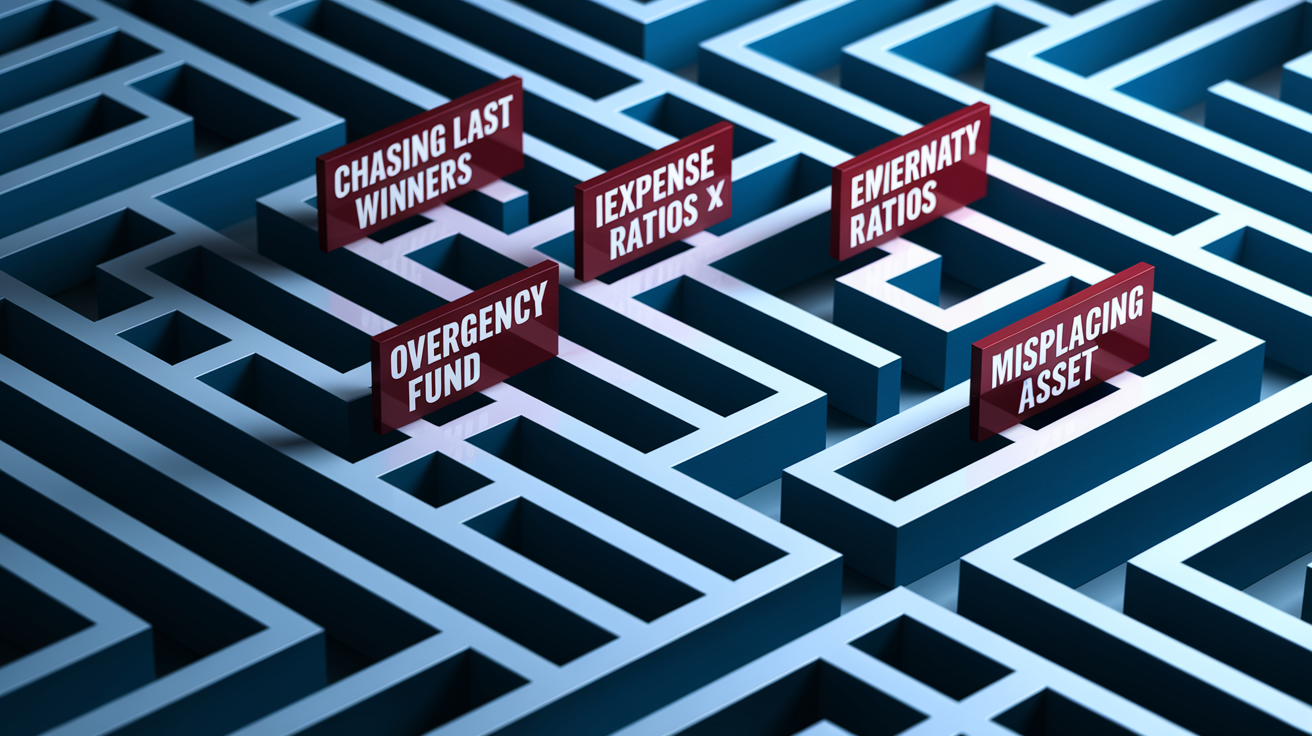
Most beginner mistakes come from reacting to short-term noise or misunderstanding what low cost really means. Staying disciplined and keeping your system simple prevents nearly all of them.
Chasing last year’s winners. Sectors that performed well recently often mean-revert. Stick with broad total market funds instead of rotating into tech, energy, or small-cap funds based on recent performance.
Ignoring expense ratios. A 0.50% fund and a 0.05% fund may look similar on a factsheet, but the cost difference erodes tens of thousands of dollars over decades.
Overtrading. Frequent buying and selling increases transaction costs, taxes, and the chance you’ll sell low and buy high. Set your allocation and leave it alone except for annual rebalancing.
Skipping the emergency fund. Invest for the long term only after you have 3 to 6 months of expenses in cash. Without a cushion, a job loss or surprise expense forces you to sell investments at the worst possible time.
Misplacing assets across accounts. Putting bonds in taxable and stocks in your IRA flips the tax-efficient strategy. Plan account placement before you buy.
Letting allocation drift indefinitely. If you never rebalance, a long bull market can push you to 90% stocks when your plan was 60%. A sudden crash then hurts more than you expected.
Panicking during downturns. Markets drop. Sometimes by 30% or more. If you sell during the decline, you lock in losses and miss the recovery. Zoom out, remember your time horizon, and keep contributing.
Mistakes happen. When you catch one, correct it and move on. The goal isn’t perfection. It’s staying close enough to your plan that compounding and low costs do the heavy lifting while you focus on earning, saving, and living your life.
Final Words
Start with the three‑fund blueprint: a total U.S. stock fund, an international stock fund, and a total bond fund. Know what index funds do and why low fees matter. Pick low‑cost examples, choose an allocation that fits your time horizon, open a brokerage, automate contributions, and rebalance annually or at a 3–5% drift.
Following these simple steps makes constructing a low-cost index fund portfolio for beginners manageable. Stay steady, keep costs low, and let time do the heavy lifting. You’ve got this.
FAQ
Q: What is a simple three‑fund index portfolio for beginners?
A: A simple three‑fund portfolio is a core mix of a U.S. total stock fund, an international stock fund, and a total bond fund, giving broad diversification with low fees and easy rebalancing.
Q: What are index funds?
A: Index funds are funds that track a market index, offering low turnover, broad holdings, and lower fees than active funds, which helps keep returns closer to the market average.
Q: Why do fees matter and what expense ratio should I target?
A: Fees matter because small annual differences compound. Target core funds under 0.10%; many top ETFs charge 0.03% to 0.07%, keeping more of your long‑term returns.
Q: How does an ETF differ from a mutual fund?
A: An ETF trades like a stock with intraday prices and usually no minimums, while mutual funds trade once daily and may have minimum investment requirements or different share classes.
Q: Which low‑cost funds are good beginner options?
A: Good beginner options include total U.S. funds like VTI or ITOT, international funds like VXUS or SCHF, and broad bond funds like BND, AGG, or SCHZ, all with low expense ratios.
Q: How should I choose an asset allocation as a beginner?
A: Choose an allocation by matching your risk tolerance and time horizon, using sample mixes like 80/20, 60/40, 40/60, or 100% equity, and adjust as goals or timeline change.
Q: How do I open a brokerage account and buy these funds?
A: Open an account at Vanguard, Schwab, or Fidelity with your SSN and ID, fund by bank transfer, then buy ETFs or mutual funds using limit orders or set up automatic contributions.
Q: Can I use fractional shares and automatic investing as a beginner?
A: You can use fractional shares and automatic investing at many brokers, which lets you invest small amounts regularly and keep steady contributions without buying whole shares each time.
Q: When and how should I rebalance my portfolio?
A: You should rebalance annually or when allocations drift more than 3%–5%; add new contributions first, trim overweight holdings, and prioritize tax‑advantaged accounts for trades.
Q: Where should I hold stocks and bonds for tax efficiency?
A: Hold bonds, REITs, and high‑yield assets in IRAs or 401(k)s, and broad stock ETFs in taxable accounts to reduce taxable income and improve overall tax efficiency.
Q: What common mistakes should beginners avoid when building index portfolios?
A: Beginners should avoid chasing past performance, paying high fees, skipping an emergency fund, overtrading, misplacing assets across accounts, and ignoring rebalancing discipline.
Q: How much do expense ratios affect long‑term returns?
A: Expense ratios affect long‑term returns because a 0.45% annual fee gap (0.50% vs 0.05%) compounds over decades and can noticeably reduce your final balance.
Q: Are there minimum investment amounts I should know about?
A: ETFs usually have no minimum beyond the share price, while some mutual fund share classes or Admiral shares may require minimums, historically around $3,000 for certain funds.