


What if your fund could cut your tax bill without you placing a single trade?
Fund‑level tax‑loss harvesting is exactly that: the manager sells losers inside the fund to cancel gains before they flow to shareholders.
That lowers year‑end capital‑gains distributions for taxable investors, leaves more money compounding, and smooths surprise tax hits.
ETFs often have a structural edge; mutual funds may still need to sell to meet redemptions.
This post shows how managers pick losses, what you see on your 1099, and when the strategy truly helps your after‑tax returns.
Core Explanation of Fund‑Level Tax‑Loss Harvesting

Fund‑level tax‑loss harvesting is when a mutual fund or ETF sells securities at a loss to offset realized gains before those gains get passed to you as taxable distributions. The fund manager handles it. You don’t place the trades.
Here’s the mechanics. When a fund sells an appreciated holding, it creates a realized capital gain. Normally that gain would flow through to shareholders at year end as a taxable distribution. To shrink that number, the manager scans the portfolio for securities trading below cost and sells them at a loss. Those losses net against the gains inside the fund, cutting the taxable amount that lands on your 1099.
ETFs have a structural edge here. They use in‑kind redemptions to hand shares to authorized participants without triggering taxable sales, so they realize fewer internal gains to begin with. Mutual funds must sell holdings to meet redemptions, creating more gains that need offsetting or distributing.
Why you care: lower distributions mean less tax this year. That leaves more money invested and compounding. For taxable accounts, fund‑level harvesting can boost after‑tax returns over time, especially in choppy markets where plenty of positions sit underwater. Tax‑advantaged accounts like IRAs don’t benefit because gains and losses already grow tax‑deferred.
Step‑by‑Step Mechanics Within a Fund

Fund managers use a structured process to capture losses while keeping the fund’s strategy and risk profile intact.
First, they identify loss positions by comparing each security’s market value to its tax‑lot cost basis. They prioritize holdings with meaningful losses, typically down 10 percent or more, to justify transaction costs and tracking impacts.
Next, they evaluate replacement holdings that preserve exposure and style without violating wash‑sale rules or creating unintended sector bets. Common swaps include a correlated ETF, a different share class, or a sector fund that maintains beta while avoiding “substantially identical” status.
Then they execute the sale of the depreciated security, realizing the capital loss inside the fund’s accounts.
They offset realized gains by netting the new loss against gains recognized earlier in the tax year. This reduces the total taxable capital gains distributed to shareholders.
Finally, they redeploy proceeds into the replacement holding right away or hold cash temporarily if no suitable swap exists, then reinvest after the 30‑day wash‑sale window closes.
Portfolio constraints like sector limits, liquidity needs, and risk targets shape which losses can be harvested and which replacements work. Managers balance tax efficiency with investment discipline, avoiding trades that would spike tracking error or violate the fund’s stated strategy.
Comparison to Account‑Level Tax‑Loss Harvesting

Account‑level tax‑loss harvesting means you sell a security in your taxable brokerage account to realize a loss, then use that loss to offset your personal capital gains or ordinary income. You control timing, replacement choice, and when to reinvest.
At the account level, the benefits belong to you alone. You can carry forward unused losses indefinitely and use them against future gains or claim up to $3,000 per year against ordinary income. Fund‑level harvesting doesn’t create personal loss carryforwards. It only reduces the fund’s distributions.
You also face wash‑sale rules on every purchase and sale you make, including across your IRA and taxable accounts. If you sell Fund A at a loss and buy Fund A again within 30 days or buy it in your IRA, the loss gets disallowed.
The two systems coexist because they serve different needs. Account‑level harvesting gives you precise control and direct tax benefits, but it requires time, attention, and enough holdings to generate meaningful losses. Fund‑level harvesting mutualizes the benefit across all taxable shareholders and uses professional resources to monitor thousands of positions continuously.
ETFs are structurally better at fund‑level efficiency because of in‑kind creation and redemption, which sidesteps many taxable sales. Mutual funds must sell securities to meet redemptions, so they rely more heavily on active harvesting to keep distributions low.
| Method | Who Benefits | Key Limitation | Tax Outcome |
|---|---|---|---|
| Fund‑level harvesting | All taxable shareholders in the fund | No personal loss carryforward; no investor control over trades | Lower capital‑gains distributions; reduced year‑end tax bill for taxable accounts |
| Account‑level harvesting | Individual investor only | Requires personal monitoring; wash‑sale risk across all accounts | Direct loss carryforward; offset against personal gains and up to $3,000 ordinary income |
| ETF in‑kind redemption | All ETF shareholders | Not available for mutual funds; passive structure limits active harvest opportunities | Minimal taxable distributions; very high after‑tax efficiency |
| Mutual fund active harvesting | All mutual fund shareholders | Higher turnover and transaction costs; risk of tracking error | Reduced distributions relative to non‑harvesting funds; still higher than most ETFs |
Investor Tax Implications and Distribution Effects

When a fund harvests losses at the portfolio level, those losses directly reduce the realized capital gains that must be distributed to you at year end. Every dollar of loss offsets a dollar of gain before the fund calculates your 1099‑DIV.
If a fund realizes $100,000 in gains and $80,000 in losses, it distributes only $20,000 in taxable gains to shareholders instead of the full $100,000. Your share depends on how many shares you own, but the principle is the same: lower distributions mean lower taxes.
After‑tax returns improve for taxable investors because you keep more money invested. If you avoid paying a 15 percent long‑term capital‑gains tax on $500 of distributions, that’s $75 you can leave in the fund to compound. Over years, the benefit accumulates, especially in volatile markets where the fund can harvest and reinvest losses repeatedly. Funds that actively harvest losses can produce after‑tax returns several basis points higher than comparable non‑harvesting funds, depending on the manager’s skill, the market environment, and the fund’s turnover profile.
What doesn’t change: your personal cost basis in the fund shares you own, your ability to harvest losses at the account level if you sell the fund itself, and your responsibility to track your own wash‑sale windows. Fund‑level harvesting doesn’t give you a direct tax deduction on your return. It only reduces the income the fund reports to you. You remain free to manage your own positions and to harvest losses on the fund shares themselves if they fall below what you paid.
Lower capital‑gains distributions each December can be especially valuable in years when the market rallies and many funds are forced to distribute large embedded gains. You get smoother year‑to‑year tax exposure, reducing the surprise of a big distribution in a strong year.
But you have no direct control over which securities the fund sells or when. You trust the manager’s judgment and process. You can’t carry forward the fund’s losses on your personal tax return. The losses stay inside the fund and offset only fund‑level gains.
You’ll still face eventual capital‑gains tax when you sell your fund shares, based on your personal cost basis. Fund‑level harvesting defers taxes on distributions but doesn’t eliminate your tax when you exit the position.
Benefits and Drawbacks of Fund‑Level Harvesting

The main advantages center on tax efficiency at scale and continuous professional execution. Fund‑level harvesting reduces realized gains that would otherwise become taxable distributions, letting you defer more tax and keep more capital invested.
ETFs enjoy structural in‑kind efficiencies that amplify this benefit, often producing zero or near‑zero capital‑gains distributions even in strong years. Active mutual funds that harvest losses can narrow the tax gap, offering better after‑tax performance than traditional funds that ignore tax consequences. For investors who hold funds in taxable brokerage accounts, especially over multi‑year periods, these distribution savings compound into meaningful after‑tax alpha.
Reduced capital‑gains distributions lower your annual tax bill and leave more assets compounding inside the fund. You get a smoother tax profile year to year, reducing the risk of a surprise distribution spike after a strong market run. ETF in‑kind efficiency can eliminate most taxable events inside the fund, making distributions rare even without active harvesting.
There’s potential tracking error when the fund replaces a sold security with a different holding to avoid wash‑sale rules. The replacement may not move in lockstep with the original position. You have reduced discretion because you can’t choose which losses to realize or when. The fund’s process may not align with your personal tax situation.
Wash‑sale interactions can trip you up if you trade the same securities the fund just sold. Buying an individual stock or a similar ETF within 30 days can disallow your personal loss if you later sell at a loss.
Situations exist where the benefits are limited or counterbalanced. Funds with very low turnover or passive index strategies have fewer realized gains to offset, so harvesting delivers smaller incremental value. Funds constrained by tight tracking‑error budgets or sector limits may skip harvest opportunities to avoid deviating from the benchmark.
And if a fund’s harvesting strategy increases turnover enough to generate short‑term gains or higher transaction costs, the gross‑return drag can exceed the after‑tax benefit, leaving you worse off than in a simpler, lower‑cost fund.
Numerical Examples of Tax Impact
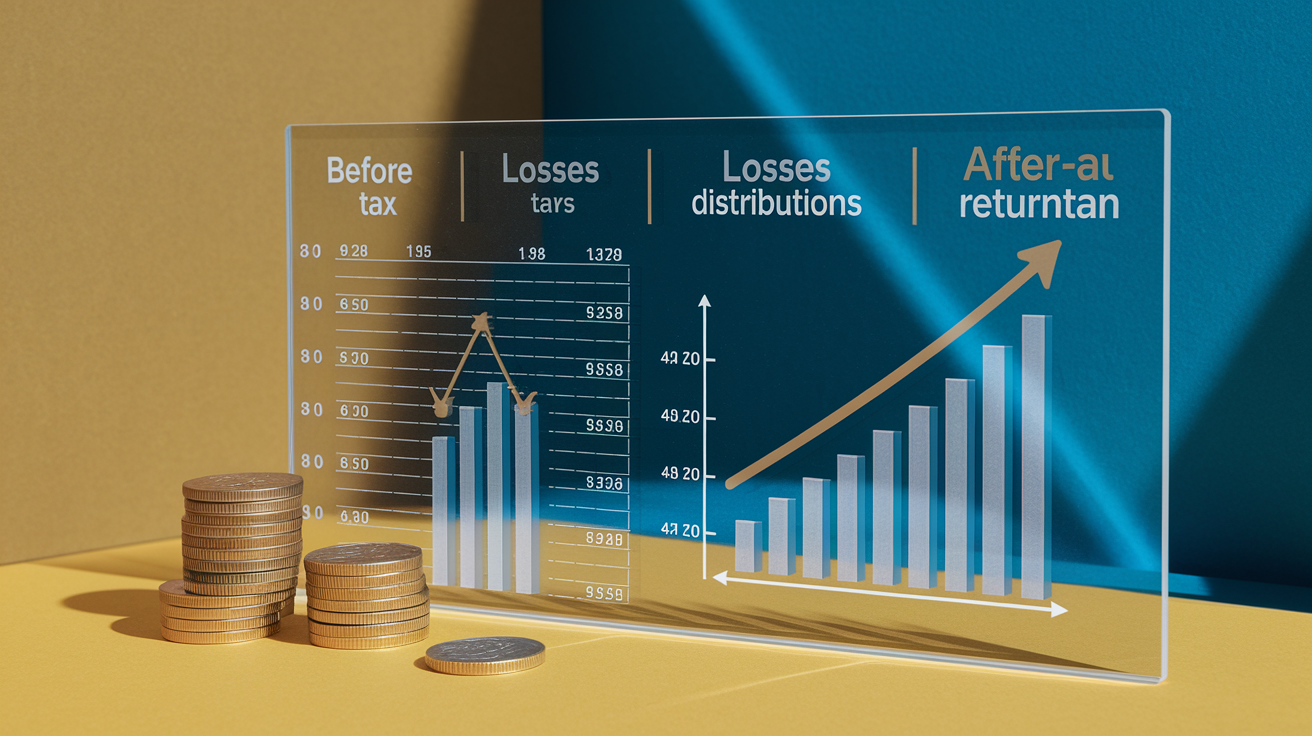
Consider a simplified scenario: a U.S. equity fund holds $10 million in assets and during the year realizes $500,000 in long‑term capital gains from selling appreciated stocks. Without any loss harvesting, the entire $500,000 would be distributed to shareholders at year end.
An investor with a $100,000 position, representing 1 percent of the fund, would receive $5,000 in taxable long‑term gains. At a 15 percent federal long‑term capital‑gains rate, that investor owes $750 in tax.
Now assume the fund manager identifies and sells positions with $300,000 in accumulated losses, netting the losses against the gains. The fund now distributes only $200,000 in capital gains. The same investor receives $2,000 in taxable distributions instead of $5,000, reducing the tax bill to $300. Cash savings of $450 for that year alone.
| Scenario | Gains | Losses | Distribution (for 1% investor) | After‑Tax Return Impact (15% tax rate) |
|---|---|---|---|---|
| No harvesting | $500,000 | $0 | $5,000 | –$750 tax; net after‑tax gain = fund gain – $750 |
| With harvesting | $500,000 | $300,000 | $2,000 | –$300 tax; net after‑tax gain = fund gain – $300; savings of $450 |
| Full offset | $500,000 | $500,000 | $0 | $0 tax; net after‑tax gain = fund gain – $0; savings of $750 |
Over multiple years, these incremental tax savings compound. If the investor reinvests the $450 saved in year one and earns 6 percent annually, that $450 grows to roughly $760 after ten years. Multiply that effect across many harvest cycles, and the cumulative after‑tax advantage can add 20 to 50 basis points per year relative to an identical fund that doesn’t harvest losses, especially in volatile markets where the fund can capture losses regularly without sacrificing exposure.
Final Words
We explained how fund managers sell securities at a loss inside pooled funds to offset gains, the step-by-step mechanics, and how that differs from harvesting in your own account.
You saw how lower realized gains can shrink year-end distributions, the pros and cons, and numerical examples that make the effect concrete.
Quick takeaway: fund-level tax-loss harvesting how it works and investor impact is simple. Pooled losses can reduce taxable distributions but don’t give you personal loss carryforwards. Use that when choosing funds and stay steady — small tax wins add up over time.
FAQ
Q: What is fund-level tax-loss harvesting?
A: Fund-level tax-loss harvesting is when a pooled fund sells securities at a loss to offset gains inside the fund; investors don’t directly control those trades.
Q: How does fund-level tax-loss harvesting work inside a pooled fund?
A: Fund-level tax-loss harvesting works by identifying losses, selling depreciated holdings, netting those losses against gains, and lowering the fund’s taxable distributions to shareholders.
Q: What are the typical steps fund managers follow to harvest losses?
A: Fund managers follow steps: identify losses, pick replacement holdings, sell the losers, match losses against gains, then reinvest to keep the fund’s risk and mandate intact.
Q: How does fund-level harvesting differ from account-level harvesting?
A: Fund-level harvesting happens inside the pooled fund and lowers distributions; account-level harvesting is done by you, creates personal loss carryforwards, and is subject to your wash-sale rules.
Q: Can I claim fund-level losses on my personal tax return?
A: Fund-level harvesting does not let you claim those losses personally; it reduces fund distributions but you don’t get individual loss carryforwards or basis changes from the fund’s trades.
Q: How do fund distributions change when managers harvest losses?
A: When managers harvest losses, year-end capital-gains distributions tend to be smaller, producing lower taxable payouts for shareholders and potentially improving after-tax returns for taxable accounts.
Q: Do wash-sale rules apply to fund-level harvesting?
A: Wash-sale rules generally don’t apply to trades made inside a fund for shareholders, but they still apply to your separate personal trades when you buy similar securities within 30 days.
Q: Are ETFs or mutual funds better at fund-level tax-loss harvesting?
A: ETFs often use in-kind redemptions that reduce taxable gains, while mutual funds more frequently realize internal gains, so ETFs are generally more tax-efficient at the fund level.
Q: What are the main benefits and drawbacks of fund-level harvesting?
A: Fund-level harvesting reduces fund distributions and smooths taxes, but can cause tracking error, force trades during volatility, and limit investor control over specific tax outcomes.
Q: How much tax savings can fund-level harvesting provide?
A: In one example, a fund with $50,000 gains and $30,000 losses cuts taxable distributions by 60%, lowering shareholder tax bills and raising after-tax returns by a measurable but variable amount.