


What if the number on a fund sheet is quietly stealing your returns?
Fund turnover (how often a fund swaps holdings in a year) shows how much trading happened inside a fund.
High turnover can mean higher costs, more taxes, and smaller long-term gains.
But turnover isn’t always bad. Context matters: strategy, tax account, and expense ratio change the story.
This post will show you how to read turnover, spot red flags, and decide when trading makes sense so you keep more of your money.
Interpreting Fund Turnover Rate for Immediate Investor Clarity

Fund turnover shows you how often a portfolio’s holdings get swapped out over the course of a year. You’re basically seeing how much trading activity happened inside the fund, written as a percentage of what the portfolio’s worth on average.
If you spot a 20% turnover, about one-fifth of the holdings changed. A 100% turnover? The whole thing got replaced. See 120%? Positions got flipped in and out even more than once.
Turnover isn’t good or bad on its own. It lives on a range. Passive funds and buy-and-hold approaches usually stay below 20%. Active managers who trade a lot often run past 50%, and some tactical funds blow past 100%.
Here’s what different levels tell you:
Under 20% means fewer trades, lower costs, and less tax mess. Works well if you’re holding long term or want to keep Uncle Sam’s hand out of your gains.
20 to 50% suggests the manager’s making some active calls without constantly reshuffling the deck.
50 to 100% is frequent buying and selling. Expect higher costs and more taxable events.
Above 100% means the portfolio might turn over more than once a year. You’re looking at serious trading costs and short-term capital gains unless there’s a good reason for it.
Don’t judge turnover alone. Match it to the fund’s strategy and your tax situation. A tactical fund should have higher turnover. A passive index fund shouldn’t.
Every trade creates costs. Spreads, fees, potential tax hits. In a taxable account, selling often means short-term gains taxed like regular income. That eats your return. Lower turnover helps compounding work better because there’s less friction dragging you down.
Understanding Fund Turnover Calculation and Ratio Mechanics
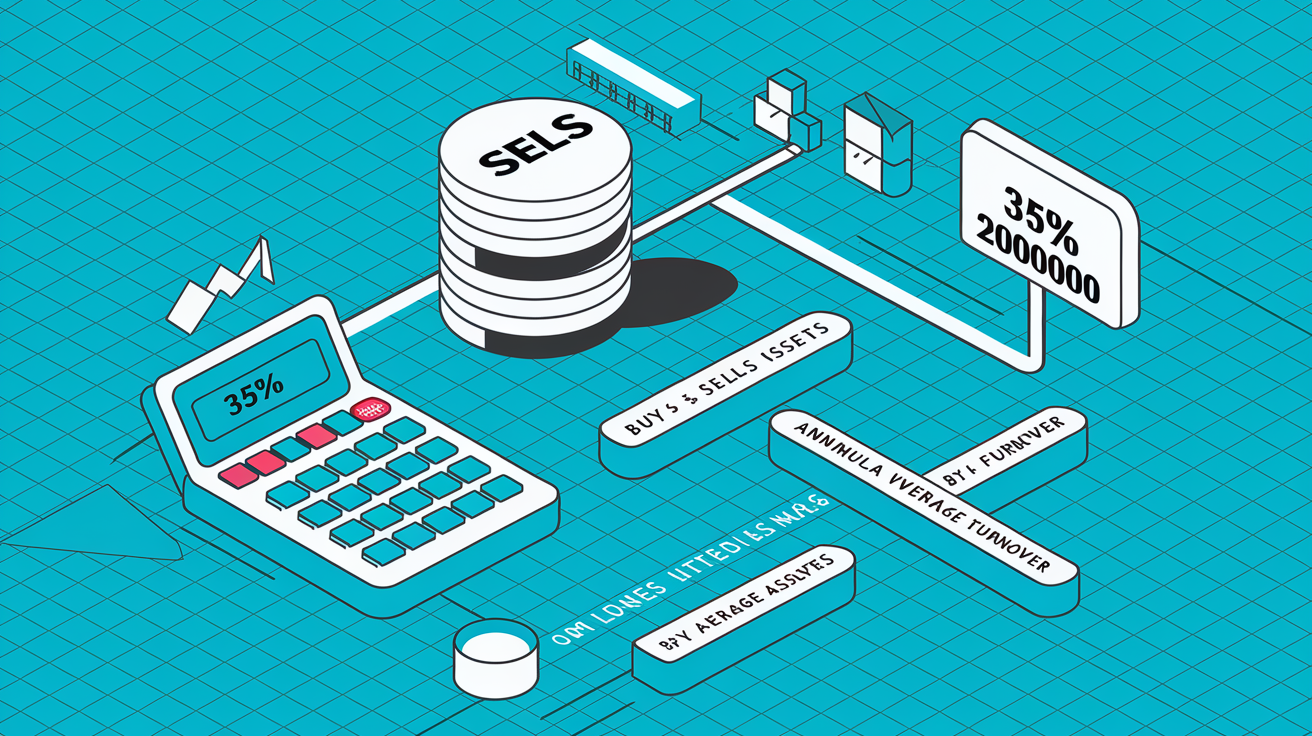
The turnover formula compares how much trading happened to the portfolio’s size. Take whichever’s smaller between total buys and total sells during the period, then divide by average assets. You get a percentage.
Say a fund buys $800,000 worth of stuff and sells $700,000 over the year. Average assets sit at $2,000,000. The smaller number is $700,000. Divide that by $2,000,000 and you land at 35% turnover.
Funds report turnover annually in prospectuses and annual reports. Some publish it quarterly. The window is usually twelve months, rolling forward each time they disclose. Annualized turnover gives you an apples-to-apples view across different fund types.
You can dig up turnover data in four places:
Fund factsheets. Usually a one-pager with the basics.
Annual reports and shareholder letters. More detail on holdings and trading.
SEC filings. Form N-CSR for registered funds has the official numbers.
Fund company websites. Check under documents or reports.
Most companies just list one percentage. If you see something wild like 150% or 200%, it means positions got replaced multiple times in a year. Can’t find it or the number’s unclear? Check the annual report footnotes or just ask investor relations.
Fund Turnover Rate Benchmarks by Fund Style and Category
What counts as normal turnover depends on the fund’s approach. Passive index funds track a benchmark and only trade when the index changes or cash flow needs adjusting. Active equity managers make calls based on research. Short-term tactical plays chase momentum and rotate constantly, so turnover spikes.
Broad market index ETFs usually come in under 10%. Large-cap value funds and dividend strategies often land between 20 and 40%. Growth funds bounce around 50 to 80% as managers swap in and out of stories. Small-cap and sector rotation strategies can blow past 100%, especially when markets get choppy or managers hunt quick wins.
Here’s how to read the ranges:
| Turnover Range | What It Indicates |
|---|---|
| Below 20% | Buy and hold or index tracking. Minimal costs, low tax hit. Holdings stay stable, good for long-term compounding. |
| 20 to 50% | Moderate active calls. Some position changes but not constant. Costs stay manageable. Works if you’re okay with tactical tweaks. |
| 50 to 100% | Frequent repositioning. Higher costs, more short-term tax exposure. Common for growth funds or sector rotators reacting to market moves. |
| Above 100% | Very high trading. Portfolio replaced more than once a year. Big costs and tax drag unless the strategy demands rapid moves. |
Compare turnover to what the fund says it does. A passive S&P 500 fund with 50% turnover? Red flag. Either the manager’s wandering off-index or tracking costs are out of whack. An active small-cap fund with 80% turnover might be fine if the manager’s chasing short-duration plays or reacting to earnings. Context beats the raw number.
Look at turnover next to the expense ratio and past tax distributions. A fund with 15% turnover and a 0.05% expense ratio behaves nothing like one with 120% turnover and a 0.75% expense ratio, even if they own similar stuff. The first compounds quietly. The second bleeds friction every year unless the manager’s edge is real enough to justify it.
Final Words
You learned what fund turnover rate measures, why it matters, and the simple benchmarks that help you judge low, medium, and high turnover. We also showed where funds report the ratio and how different fund types usually compare.
Remember higher turnover often brings more trading costs and taxable events, while lower turnover tends to help long-term compounding and tax efficiency.
Use this post as a quick reference on how to interpret fund turnover rate and its impact so you can pick funds that match your time frame and tax situation. Stay steady. Small choices add up.
FAQ
Q: What does a 200% turnover rate mean for a mutual fund?
A: A 200% turnover rate means the fund replaced its holdings twice in one year, signaling heavy trading, higher transaction costs and frequent taxable events that can reduce after-tax returns unless the strategy warrants it.
Q: What is the 70 20 10 rule of investing?
A: The 70 20 10 rule of investing is a simple allocation guideline: about 70% stable core investments, 20% growth or active ideas, and 10% high-risk opportunities—use it as a starting plan you can tweak.
Q: What is a good fund turnover rate?
A: A good fund turnover rate depends on fund style: under 20% is excellent for passive funds, 20–50% is reasonable for many active funds, and higher rates need clear strategy justification because of extra costs.
Q: What is the 7% rule in ETF?
A: The 7% rule in ETF is not an industry standard; some investors use a 7% turnover cutoff as a quick test for low trading, but check each ETF’s disclosures for accurate turnover and tax details.