


What if where you park an investment matters more than the investment itself?
Small placement moves can add about 0.75% a year to your after-tax return, which compounds into tens of thousands over decades.
This post will show simple, practical rules for placing funds between taxable accounts, tax-deferred retirement accounts, and Roth accounts so you pay less tax and keep more of your gains.
Put high-growth assets where they grow tax-free, tuck income-heavy funds into tax-deferred accounts, and keep tax-friendly funds in taxable accounts, and you’ll boost long-term returns without risky bets.
Strategic Overview of Tax‑Efficient Fund Placement Across Account Types

Asset location strategy is just where you park each investment. Taxable brokerage accounts, tax-deferred retirement accounts (traditional IRAs, 401(k)s, 403(b)s), and tax-advantaged Roth accounts (Roth IRAs, Roth 401(k)s). Tax-efficient fund placement tries to shrink the total tax you’ll pay over your lifetime by matching asset types to the account wrappers that treat their income and growth best.
When you hold funds in a taxable account, interest, dividends, and realized capital gains get taxed the year they happen. Interest and non-qualified dividends? Ordinary income rates. Long-term capital gains? You’ll pay 0%, 15%, or 20% depending on your taxable income and filing status. Short-term gains get hit at ordinary rates too. Tax-deferred accounts work differently. Everything defers until you take money out, and distributions get taxed as ordinary income. Roth accounts grow tax-free and produce zero taxable income on qualified withdrawals after age 59.5 and a five-year holding period.
Getting placement right can add an estimated 0.75% per year to your after-tax return. Sounds small. But over thirty years that difference compounds into tens of thousands of dollars you get to keep. Qualified dividends from U.S. corporations and many foreign stocks are taxed at the lower long-term capital gains rates, which makes equity index funds more tax-friendly in taxable accounts than bond funds spitting out ordinary-income interest. Holding low-turnover stock funds in a taxable account lets you defer gains until you choose to sell, then pay only the preferential 15% or 20% rate (or 0% if your income is low enough).
The core placement rules:
Put your highest expected return assets (typically equities and growth funds) in Roth or HSA accounts where future gains will never be taxed.
Place tax-inefficient assets that generate ordinary income (taxable bonds, REITs, actively managed funds, high-yield bond funds) in tax-deferred accounts to defer taxation.
Hold tax-efficient assets (municipal bonds, low-turnover equity index ETFs, tax-managed funds) in taxable accounts where qualified dividends and long-term gains receive favorable treatment.
Keep volatile assets in taxable accounts when possible to harvest tax losses that can offset up to $3,000 of ordinary income each year and carry forward indefinitely.
Favor Roth accounts over traditional tax-deferred accounts for assets you expect to appreciate the most, because withdrawing growth tax-free beats withdrawing it as ordinary income.
Tax-Efficient Placement of Funds in Taxable Brokerage Accounts

Taxable brokerage accounts tax income and gains as they occur, so your planning revolves around cutting down annual taxable events. Municipal bonds make sense here because municipal bond interest is generally exempt from federal income tax (and often state tax if you buy bonds issued in your home state). Holding munis inside a tax-deferred or Roth account wastes that exemption. You’d either defer tax-free income you never owed or lock up tax-free income that was already tax-free.
ETFs have a structural edge. Most equity ETFs distribute very few capital gains each year because they use in-kind redemptions to flush out low-basis shares. You control the timing of taxation by choosing when to sell. Qualified dividends from U.S. stocks and many international equities are taxed at long-term capital-gains rates, not ordinary rates, which keeps the tax bite smaller.
Tax-loss harvesting is easier in taxable accounts. You can sell a losing position, realize the loss to offset gains (or up to $3,000 of ordinary income per year), and immediately buy a similar but not substantially identical fund to maintain your allocation. Favoring ETFs and tax-managed index funds over traditional actively managed mutual funds helps you avoid those big year-end capital-gains distributions that hit even when you haven’t sold a share.
Optimal taxable holdings:
Municipal bond funds and individual munis for tax-exempt income
Total-market or S&P 500 equity index ETFs with low turnover and qualified dividend payments
Tax-managed equity funds designed to cut distributions
Individual stocks you plan to hold long-term or donate to charity, taking advantage of step-up in basis at death or avoiding capital gains via charitable contributions
You can also hold low-basis appreciated stock in a taxable account if you plan to leave it to heirs. Non-spouse beneficiaries receive a step-up in cost basis to the date-of-death market value, erasing the embedded capital gain and the associated tax. If you plan to donate appreciated shares to charity or a donor-advised fund, holding those shares in taxable lets you deduct the full fair-market value while avoiding capital-gains tax entirely. That’s a powerful combination you can’t replicate inside retirement accounts.
Optimal Placement of Assets in Tax-Deferred Retirement Accounts
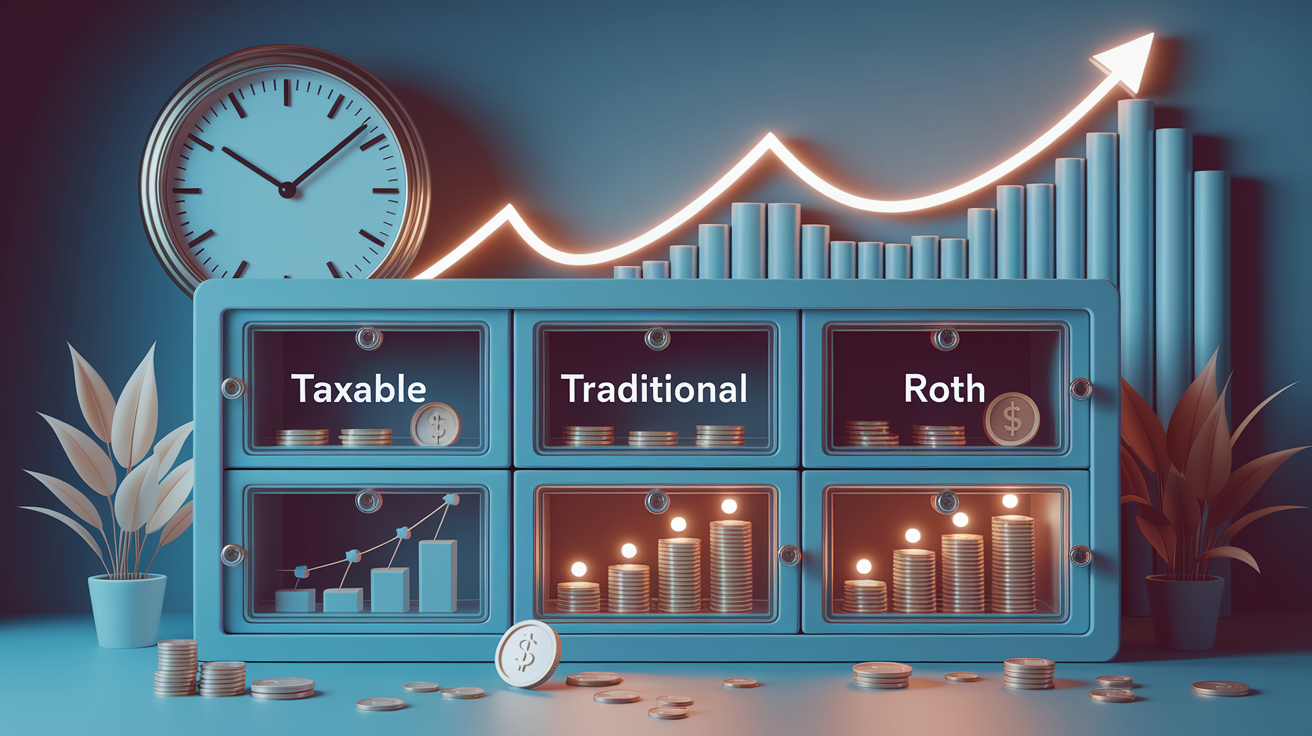
Tax-deferred retirement accounts like traditional IRAs and 401(k)s let investments grow without triggering annual tax on interest, dividends, or realized gains. Every dollar withdrawn is taxed as ordinary income, regardless of whether the underlying gain came from interest, dividends, or long-term capital appreciation. Deferral is strongest for assets that would otherwise generate high annual taxable income, because it turns yearly tax payments into a single future tax bill, and compounding on the pre-tax principal boosts wealth.
Required minimum distributions kick in after age 73 or 75 (depending on your birth year under current law). RMDs force you to withdraw and pay tax on a portion of your traditional account balance each year. Placing lower expected return assets (like bonds) inside these accounts can keep the account from growing too large and pushing you into higher brackets late in life. Early withdrawals before age 59.5 generally trigger a 10% penalty on top of ordinary income tax, so you want stable, income-producing assets here rather than volatile holdings you might need to tap early.
| Asset Type | Tax Issue | Why Tax-Deferred Helps |
|---|---|---|
| Taxable bond funds | Interest taxed annually at ordinary rates | Defer all interest until withdrawal; compound on full pre-tax amount |
| REITs and REIT funds | High ordinary-income distributions, little qualified dividend treatment | Avoid annual ordinary-income tax hit; defer until retirement when marginal rate may be lower |
| Actively managed equity funds | Frequent capital-gains distributions taxed yearly | Eliminate annual distribution taxes; gains compound tax-deferred |
Placing these assets in tax-deferred accounts turns what would be yearly tax bills into deferred liabilities. If your marginal tax rate in retirement is lower than during your working years, you pay less total tax over your lifetime. Rebalancing is simpler inside these accounts too. You can sell bonds and buy stocks, or vice versa, without triggering any immediate tax, making it easier to maintain your target allocation as markets move.
Tax-Free Account Strategy: High-Return Assets in Roth Accounts

Roth accounts (Roth IRAs and Roth 401(k)s) offer tax-free growth and tax-free qualified withdrawals, making them the most valuable real estate in your portfolio for assets you expect to grow the most. You can withdraw contributions at any time tax-free and penalty-free, and withdraw earnings tax-free and penalty-free once you reach age 59.5 and have held the account for at least five years. Because you never pay tax on Roth growth, placing your highest expected return investments (small-cap growth funds, individual high-growth stocks, emerging-market equities) inside Roth accounts locks in decades of compounding without ever sharing gains with the IRS.
Converting traditional IRA dollars to Roth accelerates taxable income into the conversion year. Strategic conversion amounts aim to fill low tax brackets in years when your income dips (early retirement before Social Security starts, a sabbatical, or a year with large business losses) so you pay tax at 12% or 22% today instead of 24% or 32% later. Tax consequences of conversions include the immediate tax bill, potential impacts on Medicare premiums (IRMAA surcharges), and taxation of Social Security benefits if the conversion pushes modified adjusted gross income above thresholds. But converting high-growth assets when they’re temporarily down in value can amplify the long-term benefit. You pay tax on a smaller base and the subsequent rebound grows tax-free.
Placing high-return assets in Roth accounts does increase your after-tax risk-adjusted exposure. Roth dollars are “bigger” in purchasing power than traditional IRA dollars. $100,000 in Roth is worth $100,000 after tax, while $100,000 in a traditional IRA might be worth only $70,000 after you pay income tax on withdrawal. This isn’t a free lunch. It’s a deliberate choice to tilt your tax-adjusted allocation toward equities. Balancing Roth, traditional, and taxable buckets gives you flexibility to manage tax brackets in retirement by choosing which account to tap each year.
Four Roth-specific placement rules:
Prioritize small-cap, international, and sector funds with high long-term growth potential but higher volatility.
Use Roth accounts for individual stocks in companies you believe will multiply in value over decades.
Consider holding the equity portion of your portfolio in Roth and the bond portion in traditional accounts, especially if you expect stock returns to significantly exceed bond returns.
Max out Roth contribution limits (including mega-backdoor Roth rollovers and employer Roth 401(k) matches when available) and use those dollars for your growthiest bets.
Comparison of Tax-Efficient Placement Across All Account Types

International stocks held in taxable accounts let you claim the foreign tax credit on your U.S. return for taxes paid to foreign governments. Holding the same fund in a Roth account means you lose that credit because Roth income is never reported. For most investors the credit is modest, often a wash against the slightly higher dividend yields on international equities. But if you hold large positions in high-tax countries, taxable placement can recover hundreds of dollars per year. Municipal bonds yield meaningfully more after tax in taxable accounts because their interest is federally tax-exempt. Locking them inside a retirement account wastes that exemption.
REITs generate mostly ordinary income with limited qualified dividend treatment, so they almost always belong in tax-advantaged accounts (either traditional or Roth) to avoid annual taxation at your top marginal rate. TIPS (Treasury Inflation-Protected Securities) adjust principal for inflation each year, and the IRS taxes that phantom income annually even though you don’t receive cash. That makes them tax-inefficient in taxable accounts. They fit better in tax-deferred or Roth wrappers. Total-market equity ETFs work well in either taxable or Roth accounts because they distribute minimal capital gains and pay mostly qualified dividends. The choice between taxable and Roth depends on whether you value liquidity and step-up in basis (taxable) or decades of tax-free compounding (Roth).
| Asset Type | Best Account | Tax Reason | Notes |
|---|---|---|---|
| Municipal bonds | Taxable | Interest is federally tax-exempt | No benefit inside retirement accounts; maximize after-tax yield in taxable |
| Total-market equity ETFs | Taxable or Roth | Qualified dividends + low turnover; minimal distributions | Taxable offers liquidity and step-up; Roth offers tax-free growth |
| Taxable bond funds | Tax-deferred (401(k)/IRA) | Interest taxed as ordinary income | Defer annual taxation; compound pre-tax |
| REITs and REIT funds | Tax-deferred or Roth | High ordinary-income distributions | Avoid annual ordinary-income tax; Roth best for high expected growth |
| High-growth individual stocks | Roth | Future appreciation tax-free | Maximize compounding on highest-return bets |
| International equity funds | Taxable (if capturing foreign tax credit) or Roth | Foreign tax credit available in taxable; tax-free growth in Roth | Tradeoff depends on size of credit vs. expected return |
| TIPS | Tax-deferred or Roth | Inflation adjustments create phantom taxable income | Avoid taxable accounts unless yields are very attractive |
| Actively managed equity funds | Tax-deferred or Roth | Frequent capital-gains distributions | ETF versions may be acceptable in taxable if distributions are low |
If you hold the vast majority of your wealth in tax-advantaged accounts (say 90% or more), fine-tuning asset location adds little value. Focus instead on maxing contributions and maintaining your target asset allocation. When account sizes are more balanced, thoughtful placement can meaningfully reduce lifetime taxes and boost after-tax returns.
Numeric Examples Demonstrating Tax-Efficient Fund Placement
Start with $100,000 invested for ten years. Place an 8% annual-return asset in a Roth account and a 3% annual-return asset in a taxable account (with long-term capital gains taxed at 23.8%, the top federal rate including the 3.8% net investment income tax). The Roth portion grows to $100,000 × 1.08^10, about $215,892 tax-free. The taxable portion grows to $100,000 × 1.03^10, about $134,392, with a gain of $34,392. After paying 23.8% tax on the gain ($8,185), you net $126,207. Combined: $215,892 + $126,207 = $342,099.
Flip the placement. Put 8% in taxable and 3% in Roth. The 8% asset in taxable grows to $215,892 with a gain of $115,892. Taxed at 23.8%, you pay $27,582 and keep $188,310. The 3% asset in Roth grows tax-free to $134,392. Combined: $188,310 + $134,392 = $322,702. Correct placement adds $19,397, roughly 10% more wealth, from a $200,000 starting portfolio.
When both assets earn 8% but one is tax-inefficient (generating ordinary income taxed at 37% annually) and the other is tax-efficient (deferring gains), placing the tax-inefficient asset in a Roth and the tax-efficient asset in taxable yields $215,892 Roth plus roughly $188,310 taxable (because deferring gains until sale and paying long-term rates is far better than yearly ordinary taxation). Reverse it and put the tax-inefficient asset in taxable. Its after-tax compounding drops to an effective 5.04% (8% × (1 − 0.37)), growing to only $100,000 × 1.0504^10, about $163,862, while the Roth still delivers $215,892. Combined under bad placement: $163,862 + $215,892 = $379,754. Correct placement: $215,892 + $188,310 = $404,202. The $24,448 difference shows the cost of ignoring tax efficiency.
| Scenario | Roth Holding | Taxable Holding | 10-Year Combined Value |
|---|---|---|---|
| Optimal: 8% in Roth, 3% in taxable | $215,892 | $126,207 (after LTCG tax) | $342,099 |
| Reversed: 3% in Roth, 8% in taxable | $134,392 | $188,310 (after LTCG tax) | $322,702 |
| Tax-inefficient 8% in taxable vs Roth | $215,892 | $163,862 (yearly ordinary tax) | $379,754 |
Rebalancing amplifies these differences over decades. If you rebalance a 50/50 stock/bond portfolio and place stocks (8% expected) in Roth and bonds (3% expected, taxed as ordinary income at 37%) in a traditional account, after ten years you might have roughly $215,892 in Roth stocks and $100,000 × 1.03^10, about $134,392 in traditional bonds (pre-tax). Withdrawing the bonds at retirement and paying 37% tax leaves you $84,667 after tax, for a combined $300,559. Reverse the placement (bonds in Roth, stocks in taxable) and the stocks grow to $215,892 with a $115,892 gain. Paying 23.8% tax costs $27,582, netting $188,310, while Roth bonds deliver $134,392 tax-free. Combined: $188,310 + $134,392 = $322,702. Placing the higher-return asset in Roth and the lower-return ordinary-income asset in traditional saves roughly $22,143, even accounting for the future tax on bond withdrawals.
Practical Workflow for Rebalancing and Improving Tax-Efficient Placement

Most investors can’t simply sell everything and re-buy in the “right” accounts without triggering large taxable events today. You improve asset location gradually through new contributions, strategic rebalancing, and selective sales. Selling high-basis lots first minimizes realized gains, while tax-loss harvesting lets you offset gains or deduct up to $3,000 of ordinary income per year when you sell losing positions.
Start by inventorying every account (taxable, traditional, and Roth) and listing each holding’s cost basis, current value, expected return, and tax-efficiency profile. Classify assets as tax-efficient (index equity ETFs, munis) or tax-inefficient (bond funds, REITs, actively managed funds), and rank them by expected long-term return.
A six-step workflow:
Direct new contributions to fill gaps. If you’re adding $10,000 this year and your taxable account holds too many bonds, contribute that $10,000 to your 401(k) and buy bonds there, then use existing taxable cash to buy equities or leave equities in place.
Rebalance inside retirement accounts first. Sell and buy freely within traditional IRAs and 401(k)s without triggering tax. Use these trades to bring your overall allocation back to target before touching taxable holdings.
Harvest losses in taxable accounts. If an equity position is underwater, sell it, realize the loss to offset gains or $3,000 of ordinary income, and immediately buy a similar (but not substantially identical) fund to avoid a wash sale and maintain exposure.
Sell high-basis lots when you must sell in taxable. Use specific identification (not FIFO) to select shares with the highest cost basis, minimizing the taxable gain. Your brokerage must allow lot selection and you must confirm the choice at the time of sale.
Convert traditional to Roth in low-income years. If your marginal rate drops to 12% or 22% (early retirement, sabbatical, business loss year), convert enough traditional IRA dollars to fill that bracket, paying tax now at a low rate to lock in decades of tax-free growth on high-return assets.
Monitor and iterate annually. Review your asset location each year during rebalancing. As account balances shift and tax laws change, small adjustments keep you close to optimal without large taxable events.
Tax-loss harvesting works best with volatile assets in taxable accounts (technology sector funds, small-cap value, emerging markets) because periodic drawdowns create harvesting opportunities. Avoid the wash-sale rule by waiting 31 days before repurchasing the same security, or immediately buy a similar but not substantially identical fund (sell Vanguard Total Stock and buy iShares Core S&P Total U.S. Stock Market ETF). Excess losses carry forward indefinitely, building a reservoir you can use to offset future gains from rebalancing or retirement withdrawals.
Advanced Tax-Efficiency Tactics for Multi-Account Investors

Choosing which bucket to tap each year in retirement lets you control taxable income. You can access brokerage dollars at any age without penalty, making taxable accounts a bridge before age 59.5 or a source for large one-time expenses (home purchase, college, medical bills) without triggering early-withdrawal penalties. Tax-managed funds actively avoid realizing short-term gains and may use tax-loss harvesting internally, though low-cost broad index ETFs often achieve similar results with even lower fees.
Required minimum distributions force withdrawals from traditional accounts starting at age 73 or 75, and those withdrawals count as ordinary income. If your traditional accounts are large relative to your spending needs, RMDs can push you into higher brackets, increase Medicare premiums, and trigger taxation of Social Security benefits. Converting during your 60s or early 70s (before RMDs begin) can shift dollars from traditional to Roth, reducing future RMD amounts and giving you more control over taxable income late in life. Converting bonds or other lower expected return assets keeps the traditional account from growing as fast, while converting high-growth equities maximizes the tax-free compounding benefit in Roth.
Donating appreciated shares to charity or a donor-advised fund lets you deduct the full fair-market value and avoid capital-gains tax entirely. You flush out low-basis shares and reset your taxable portfolio. You can then repurchase the same asset at today’s higher basis, giving you more flexibility for future tax-loss harvesting or lower gains when you eventually sell. This works only in taxable accounts. You can’t donate shares from an IRA and claim a charitable deduction for their value.
Five advanced tactics:
Foreign tax credit optimization. Hold international equity funds in taxable accounts if the foreign taxes paid exceed the benefit of tax-free Roth growth. Run the numbers yearly and rebalance if the credit becomes meaningful.
NIIT planning. The 3.8% net investment income tax applies above income thresholds ($200,000 single, $250,000 married filing jointly). Placing income-producing assets in retirement accounts and timing Roth conversions to stay below thresholds can save thousands.
Step-up-in-basis legacy planning. Hold low-basis appreciated stock in taxable accounts if you plan to leave it to heirs. Non-spouse beneficiaries receive a step-up to date-of-death value, erasing embedded capital gains and the associated tax.
Volatility and rebalancing coordination. During market drops, sell bonds inside your traditional IRA to buy equities there (no tax on the trade), and simultaneously tax-loss harvest equities in your taxable account. This rebalances your total portfolio while capturing losses to offset future gains.
ETF wrapper preference in taxable. Favor ETFs over mutual funds for all taxable equity positions to avoid surprise year-end capital-gains distributions. If you must hold a mutual fund, choose Vanguard funds that share the same ETF structure or explicitly tax-managed funds.
Withdrawal order in retirement typically starts with taxable accounts (to preserve tax-deferred compounding and delay RMDs), then shifts to traditional accounts once RMDs begin, and taps Roth accounts last to maximize decades of tax-free growth and preserve Roth dollars for high-bracket years or legacy. But if a year’s income is unusually low (after you retire but before Social Security starts), withdraw more from traditional accounts or execute a Roth conversion to fill the lower brackets, because those dollars will never be taxed more cheaply. Combining asset location, withdrawal sequencing, Roth conversions, and tax-loss harvesting into a single long-term plan can add tens of thousands of dollars to your after-tax wealth and give you far more control over your tax bill every year.
Final Words
In the action, we mapped simple rules: put high-growth holdings in Roth, income-producing or high-turnover assets in tax-deferred accounts, and tax-efficient equities or munis in taxable accounts. We also showed the tax logic and a measured benefit of about 0.75% per year.
You got a practical workflow: use new contributions first, tax-loss harvesting, smart lot selection, and occasional Roth conversions. Rebalancing and coordination keep taxes low.
Putting these steps into practice improves tax-efficient placement of funds between taxable and retirement accounts. Start small, stay consistent, and you’ll likely keep more of your returns.
FAQ
Q: Where should I place high-growth or high-return assets?
A: High-growth or high-return assets belong in Roth or HSA accounts because growth and withdrawals can be tax-free, letting compound gains avoid annual taxes and improving after-tax returns over time.
Q: Where should I place tax-inefficient, ordinary-income assets like bonds or REITs?
A: Tax-inefficient, ordinary-income assets (bonds, REITs, high-turnover funds) fit best in tax-deferred accounts since interest and ordinary income can grow tax-deferred and withdrawals are taxed later as ordinary income.
Q: What should I hold in a taxable brokerage account?
A: Taxable accounts are best for low-turnover stocks, tax‑efficient ETFs, tax‑managed funds, and municipal bonds because they minimize yearly taxable income and avoid frequent capital-gain distributions.
Q: How are dividends, interest, and capital gains taxed in taxable accounts?
A: Dividends and interest in taxable accounts are taxed each year; long-term capital gains use 0/15/20% rates, while short-term gains and nonqualified income are taxed as ordinary income.
Q: How much can correct asset location improve returns?
A: Correct asset location can boost after-tax returns by about 0.75% per year on average, by reducing yearly tax drag and placing assets where their tax treatment is most favorable.
Q: How should I rebalance across taxable and retirement accounts?
A: Rebalancing should use new contributions first, then trim overweight positions in tax-advantaged accounts and sell high-basis lots in taxable accounts to limit realized gains and taxes.
Q: What does tax-loss harvesting do and how much can it offset?
A: Tax-loss harvesting captures losses to offset up to $3,000 of ordinary income each year, with extra losses carried forward indefinitely; avoid wash-sale rules when repurchasing similar holdings.
Q: When should I consider Roth conversions and how do RMDs factor in?
A: Roth conversions are worth considering in lower-income years because they shift future growth to tax-free Roths and reduce future RMD exposure; RMDs start at ages tied to your birth year (73 or 75).
Q: What advanced tactics help multi-account investors optimize taxes?
A: Advanced tactics include donating appreciated shares, using donor-advised funds, coordinating foreign tax credits in taxable accounts, timing Roth conversions, and planning withdrawals to minimize lifetime taxes.
Q: Are ETFs generally better than mutual funds for taxable accounts?
A: ETFs often beat mutual funds in taxable accounts because they tend to have lower turnover and fewer capital‑gain distributions, reducing annual taxable events for investors.